
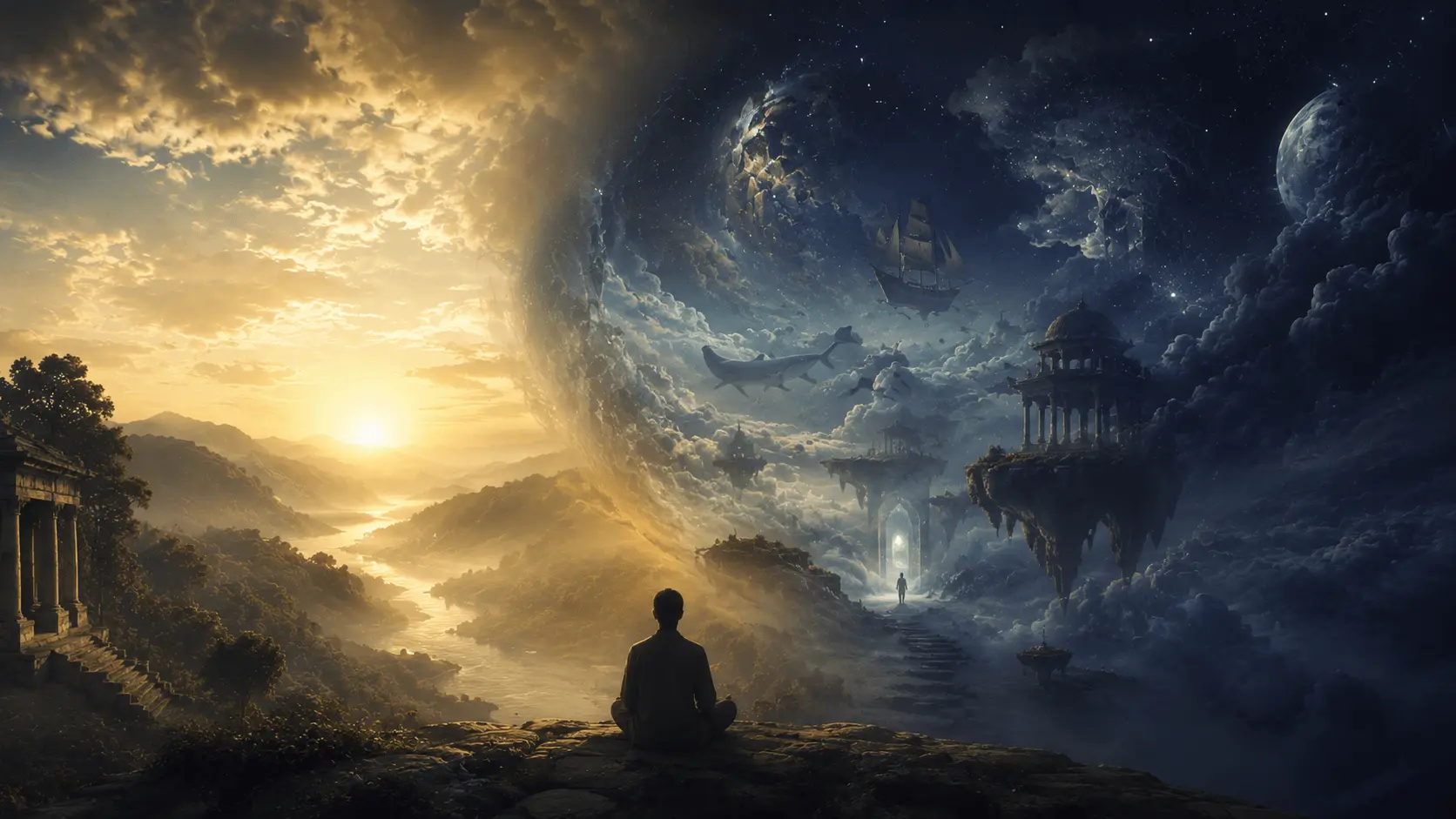
You close your eyes, fall asleep, and disappear from the familiar world.
Then, without leaving your bed, you find yourself somewhere else.
You may be walking through an unknown landscape, speaking to people who are not physically present, experiencing fear, pleasure, sorrow, or thrill. You may see places that never existed and yet feel completely familiar. For the duration of the dream, you do not usually stand outside the experience and remind yourself that it is a dream. You live through it.
Then you wake.
The entire world disappears.
What seemed so convincing a moment earlier is suddenly recognized as a dream.
But this raises a deeper question. If consciousness can experience an entire world while the physical senses are withdrawn from their ordinary activity, what exactly is happening in the dream state?
The Māṇḍūkya Upanishad approaches this question not simply as a study of dreams, but as part of a much larger investigation into consciousness. It gives the dream state a specific name: Taijasa.
Taijasa is described as the second state, or second “foot,” of Ātman. It is associated with svapnasthāna, the dream state; antah-prājña, inward consciousness; and pravivikta-bhuk, experience of subtle objects.
The importance of Taijasa lies in what the dream reveals.
When the external world recedes, consciousness does not necessarily become blank. A different field of experience appears.
And that simple observation opens a serious inquiry:
What is the nature of the consciousness that experiences the dream?
Taijasa: The Consciousness of the Dream State
The Māṇḍūkya Upanishad presents consciousness through distinct states of experience. The second of these is associated with dreaming and is called Taijasa.
The term is connected with the dream condition, but Taijasa should not be understood merely as a label for a sleeping person.
It refers to the mode of consciousness associated with the dream state.
The traditional description gives several characteristics.
Taijasa has dream as its field. It is inwardly conscious rather than directed toward the external world in the same way as waking consciousness. It experiences subtle objects rather than the gross physical objects encountered through ordinary waking perception.
This distinction between the gross and the subtle is central.
In waking experience, we appear to encounter an external world ourselves. We see physical objects, hear sounds, touch things, interact with people, and respond to circumstances.
Dreaming is different.
The eyes may be closed, but there is seeing.
Ordinary external sounds may not reach the ears, but hearing can still occur.
The physical body may remain in bed, yet the dream can contain movement, sensation, and interaction.
The source describes this as a turning inward of consciousness. The dreamer experiences a world without depending upon the ordinary waking operation of the physical senses.
This is what the description antah-prājña, inwardly conscious, helps us understand.
The dream is not simply a smaller version of waking life.
It is a different mode in which consciousness presents experience.
When the Outer World Falls Away
Think about the transition into a dream.
During waking life, attention is continuously occupied by the world around us. There are people to respond to, objects to recognize, sounds to interpret, and situations to navigate.
In a dream, that familiar external framework can disappear.
Yet the mind does not necessarily become empty.
Instead, an entirely different world may arise.
This is one of the most striking aspects of the dream state.
The dreamer does not generally experience the dream as a collection of disconnected images. There may be a landscape, a body, other people, events, emotions, and a sense of time. There can be a complete relationship between the person experiencing the dream and the environment being experienced.
The dream therefore has its own field of experience.
That is why the Māṇḍūkya description of Taijasa is so important. It does not approach dreaming simply by saying that the physical world has disappeared. It asks us to notice that another kind of experiential world has appeared in its place.
Consciousness has not ceased to function.
Its field has changed.
What Does “Inwardly Conscious” Really Mean?
The expression antah-prājña can be understood as a description of consciousness that is oriented inward.
This does not mean that the dream is simply an abstract thought floating inside the mind.
A dream can appear remarkably concrete.
There can be visual form, sound, movement, sensation, and emotional intensity. Yet these experiences are not dependent upon the physical environment being perceived in the same way as during waking.
This creates an unusual situation.
The dreamer seems to encounter objects.
But those objects belong to the dream experience.
The dreamer appears to move through a world.
Yet the world is not physically surrounding the sleeping body.
The dreamer may even experience a dream body that seems to possess a location, movement, and sensory capacities.
The source describes the mind as dividing itself into subject and object, becoming both the seer and the seen within the dream.
That is one of the deepest insights in the discussion of Taijasa.
The dream does not simply present images to an already existing observer.
It presents an entire relationship between an observer and an observed world.
The dreamer experiences a world, while the dream world itself is part of the same field of consciousness.
The Dreamer and the Dream World
During a dream, the distinction between the dreamer and the dream world can feel absolute.
There is “me,” and everything is happening around me.
There may be people whom the dreamer speaks to, places the dreamer visits, and events the dreamer responds to.
Yet when waking occurs, something phenomenal becomes apparent.
The dreamer and the dream world disappear together.
The dream character who was “you” vanishes.
The landscape vanishes.
The people vanish.
The events vanish.
What remains is the waking experience.
The source therefore describes the dream subject and dream objects as coexisting within the same mental field, then dissolving together upon waking.
This does not mean that the waking world should automatically be declared unreal.
That would be a conclusion the teaching has not yet established.
Instead, the dream provides us with an opportunity to examine something more basic:
How does consciousness create the experience of a distinction between subject and object?
The dream gives us a particularly clear example because the relationship can be observed retrospectively.
We know that the dream world was not physically surrounding the sleeping body.
Yet, while dreaming, the distinction between “inside” and “outside” could feel completely convincing.
Why Does the Dream Feel Real?
This is where the dream becomes philosophically unsettling.
If the dream world is not physically present, why can the experience affect us so strongly?
A frightening dream can produce fear.
A pleasant dream can produce happiness.
A painful dream can seem genuinely painful.
A dream can leave a person waking suddenly with the body still reacting to what has just been experienced.
The source emphasizes precisely this problem. While dreaming, the dreamer can experience pleasure, pain, fear, satisfaction, and other emotional reactions within the dream world.
The ordinary response is to say:
“It was only a dream.”
But that statement is made after waking.
While the dream was occurring, the experience possessed a different status.
The dreamer did not usually stand outside it and dismiss it.
This leads to an important distinction.
To say that something is not ultimately or physically present is not necessarily the same as saying that the experience itself was meaningless or nonexistent.
The experience occurred.
The dreamer experienced it.
The fear was experienced as fear.
The pleasure was experienced as pleasure.
The question, therefore, is not simply whether the dream object existed physically.
The more interesting question is:
What makes an experience appear real while it is being experienced?
The Problem With Calling Dream “Unreal”
The Māṇḍūkya analysis becomes especially challenging when it calls into question the usual comparison between waking and dreaming.
Most of us assume that waking's real because waking objects have practical consequences.
Food in waking life can satisfy waking hunger. A physical object can be touched, used, and encountered by other people. Events can have consequences that continue after the particular moment has passed.
Dream objects appear different.
But the source asks us to examine whether the comparison is being made fairly. A dream has its own internal relationships. Within the dream, a dream experience can satisfy a dream desire, create a dream relationship, or produce a dream reaction.
The argument is not that waking and dreaming are identical.
They are clearly not.
Rather, the teaching questions the assumption that one state can declare the other unreal without examining the nature of experience itself.
The waking person judges the dream from the waking state.
But the dreamer, while dreaming, experiences the dream as the current world.
This difference turns crucial.
Who Is Making the Comparison?
Now the investigation takes an even more notable turn.
We can compare waking and dreaming.
We can say:
“I was awake.”
“Then I dreamed.”
“Then I woke up.”
But who is capable of making this comparison?
When you are dreaming, you are immersed in the dream.
When you are awake, you are immersed in waking experience.
You do not ordinarily stand in some neutral location simultaneously experiencing both worlds.
Yet you can remember both.
You can recognize that you passed through different states.
The source uses this problem to point to a consciousness that is not completely identifiable with either waking or dreaming.
This is the beginning of the idea of the witness.
The witness is not simply another character inside the dream.
Nor is it merely the waking personality.
It represents a deeper principle of consciousness capable of recognizing different states of experience.
This is why the analysis of Taijasa eventually leads beyond Taijasa itself.
The question begins with dreaming.
It ends by asking what consciousness is.
The Dream as a Window Into Consciousness
A dream is unusual because it allows us to observe a world that appears to exist without the ordinary external conditions of waking perception.
The dreamer sees.
The dreamer hears.
The dreamer feels.
The dreamer responds.
Yet the physical world corresponding to those experiences is absent.
This makes dreaming an especially revealing field for philosophical investigation.
It shows that experience is not as simple as object plus perception.
A world can appear within consciousness.
The mind can present itself with a subject and an environment.
And while the experience is taking place, that world can command attention just as completely as waking circumstances do.
The Māṇḍūkya teaching uses this fact not to encourage people to become obsessed with interpreting individual dreams, but to investigate the structure of experience.
What is a dream?
What is waking?
What makes either state appear real?
And what is the consciousness that knows both?
Taijasa is the starting point for these questions.
Could There Be a Reality Beyond Waking?
The dream state gives us a startling lesson.
While dreaming, the dreamer does not normally think:
“Soon I will wake up, and this world will no longer exist.”
The dream is the current reality.
Then waking occurs.
Suddenly, another world has priority.
The source asks us to consider whether waking might similarly be a state from which we have not yet awakened. If dreaming is limited because the dreamer does not know waking while dreaming, waking consciousness might also be limited by not knowing a higher state.
This is one of the boldest implications of the dream analysis.
It does not say that waking life has no practical reality.
Rather, it asks whether practical reality is the same as ultimate reality.
The source eventually connects this possibility with spiritual realization. Just as arising from a dream does not mean that one has lost something essential, awakening to God-realization is presented as a movement toward a more complete understanding rather than a deprivation.
The dream, therefore, becomes a metaphor—and more than a metaphor—for the possibility of awakening to a greater consciousness.
Taijasa and the Subtle Nature of Dream Experience
The term pravivikta-bhuk is another important part of the description of Taijasa.
The source explains that the dream consciousness is concerned with subtle things rather than gross physical objects. It uses the language of subtle elements, or tanmātrās—sound, touch, form, taste, and smell—to discuss the nature of dream experience.
The distinction between gross and subtle should not be treated as if it were a modern scientific classification.
It belongs to the traditional philosophical framework.
Within that framework, waking experience is associated with gross objects, while dream experience is associated with subtler forms.
This explains why Taijasa is not simply a diminished version of waking consciousness.
It is subtle consciousness operating within a different field.
The dream may reproduce many characteristics of waking experience, but its objects do not have the same status as physical objects encountered in the conscious world.
This gives the dream state a distinctive place in the Māṇḍūkya analysis.
Taijasa and Hiraṇyagarbha Are Not the Same
One distinction is especially important when discussing Taijasa.
Taijasa and Hiraṇyagarbha should not be treated as identical.
Taijasa belongs to the individual level of experience. Hiraṇyagarbha belongs to the cosmic level.
The source explicitly distinguishes Taijasa as the form associated with the jīva, while Hiraṇyagarbha is associated with Īśvara.
The two are related, but they are not interchangeable terms.
The individual dream consciousness is considered in relation to the individual’s experience.
Hiraṇyagarbha represents the cosmic subtle dimension.
This distinction becomes especially important when the Māṇḍūkya framework is considered as a whole, because the teaching draws correspondences between individual and cosmic levels without simply collapsing one into the other.
For that reason, Taijasa deserves to be understood on its own before its relationship with Hiraṇyagarbha is explored in greater depth.
What Taijasa Teaches Us About the Dreamer
The deepest lesson of Taijasa may not concern the contents of dreams at all.
It concerns the nature of the experiencer.
A dream can change from moment to moment.
Its people can change.
Its locations can change.
Its emotional atmosphere can change.
The dream can disappear completely.
Yet after waking, you say:
“I dreamed.”
That small statement contains a considerable continuity.
You recognize the dream as an experience that occurred.
This is why the Māṇḍūkya analysis does not stop with the question of what dreams contain. It moves toward the question of what consciousness is that passes through waking and dreaming without being exhausted by either.
The source argues that neither waking experiences nor dream occurrences completely define our being. There appears to be something capable of witnessing both.
Taijasa therefore becomes a doorway.
It begins with a dream.
It ends with an inquiry into the Self.
A Different Way to Look at Your Next Dream
The next time you wake from a clear dream, there is a simple observation you can make.
Do not immediately ask what the dream symbolized.
Instead, ask:
How did that world become my world?
For a few moments, it was unquestioned.
Then it disappeared.
The waking world took its place.
Now ask:
What is it that knows the difference between these two states?
The purpose is not to force a mystical conclusion.
The value lies in observation.
The dream gives us a rare opportunity to notice that the world we experience is not always identical to the physical environment around us.
It also allows us to notice that consciousness can be intimately involved with a world and then recognize that world as belonging to another state.
This is precisely why the dream state occupies such an important position in the Māṇḍūkya teaching.
The Deeper Meaning of Taijasa
Taijasa is easy to translate and difficult to exhaust.
At the simplest level, it refers to the consciousness associated with dreaming.
But the Māṇḍūkya Upanishad’s analysis goes considerably deeper.
Taijasa is inwardly conscious.
Its field is subtle.
The dreamer experiences a world without depending upon the ordinary external objects of waking life.
The mind can present both subject and object within the same dream experience.
The dream can possess its own apparent reality while it lasts.
And once waking occurs, the entire experience is recognized from another standpoint.
From this observation arises the larger philosophical investigation.
If dream is one state, being awake is another.
If both are states, what knows them?
If the dream appears real until waking, what guarantees that arising is the final standpoint?
And if there is a consciousness beyond both, what is its nature?
These are not questions that can be answered merely through interpreting the images of a dream.
They require us to turn attention toward the one who experiences.
That is the real significance of Taijasa.
The dream is not important only because of what we see in it.
It is important because, for a brief period each night, consciousness reveals that it can experience an entire world in a way radically different from waking.
The Māṇḍūkya Upanishad asks us to take that fact seriously.
Not as a curiosity.
Not simply as a psychological puzzle.
But as a clue in the ancient investigation of consciousness itself.
Conclusion
Taijasa is the Māṇḍūkya Upanishad’s designation for consciousness associated with the dream state. Unlike waking consciousness, which is directed toward the gross external world, Taijasa is described as inwardly conscious and associated with subtle objects. The dream state shows that consciousness can experience an entire world even when the ordinary waking environment is no longer the immediate field of experience. The greater significance of Taijasa lies in the relationship between dreamer and dream world, the apparent reality of dream experience, and the question of the consciousness capable of perceiving both waking and dreaming as states.
0 Comments