
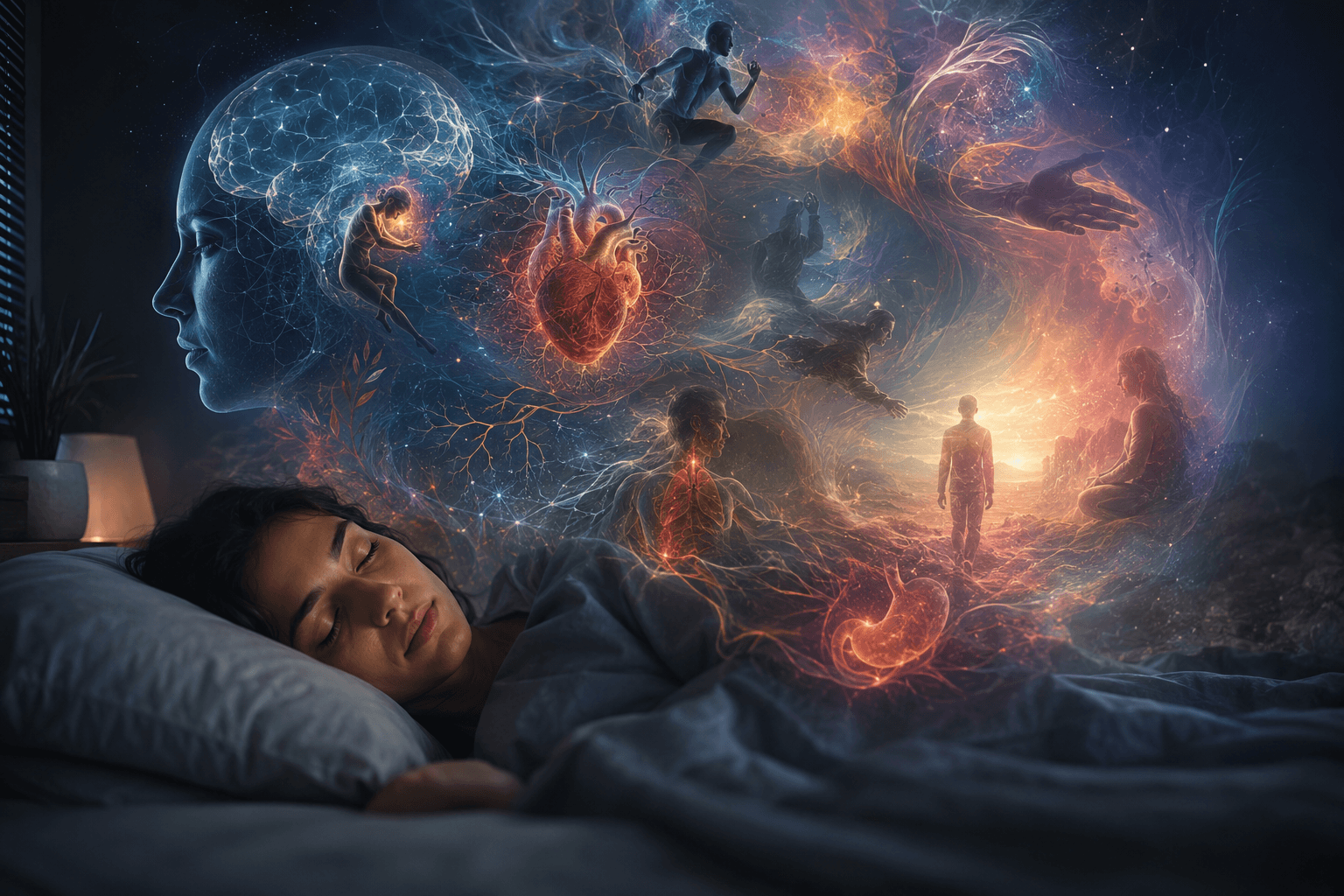
You wake up just before dawn, feeling certain that something unusual happened while you slept.
Maybe you dreamed you were drowning, with your chest tight and breathing hard. Or you felt trapped under something heavy, unable to move. Perhaps you ran through intense heat, sweating under a harsh sun. You might even have searched for a bathroom in your dream, only to wake up and realize your bladder was actually full.
Then you realize something curious: your body might have been sending signals while your mind was dreaming.
Dreams can feel like a private movie playing in your mind. But even while you sleep, your brain keeps picking up signals from your body, such as your heartbeat, breathing, temperature, discomfort, and pain. Some of these signals can shape the dreams you remember.
This helps explain why dreams can sometimes feel surprisingly physical.
Modern sleep science has begun to investigate this occurrence through the language of interoception—the brain’s ability to sense and integrate information about the body’s internal condition. (Engelen et al., 2023) Research also shows that sensory stimulation in sleep can alter dream material, although the effect is inconsistent and still poorly understood. (Carr et al., 2020) A 2024 systematic review identified 51 relevant studies and found that reported stimulus-dependent changes in dreams varied enormously across experiments. (Salvesen et al., 2024)
This creates an interesting connection between neuroscience and older Indian ideas about the body (śarīra), mind (manas), consciousness, and dreams (svapna).
However, it’s important to be clear about one thing from the beginning.
A dream might reflect something happening in your body, but that doesn’t mean it’s a medical diagnosis. Some researchers are studying whether certain dreams precede symptoms of illness, but this idea is still in its early stages.
It is scientifically reasonable to think that the sleeping body can influence the dreaming mind.
But whether a dream can reliably show what’s wrong with the body is a separate question.
What Are Somatic Dreams?
The term "somatic dream" refers to a dream in which physical sensations seem to shape what you experience.
These sensations can come from inside the body, like changes in breathing, heartbeat, temperature, digestion, or a full bladder. They can also come from outside, like pain, pressure, or an uncomfortable sleeping position.
The dream doesn’t always copy the sensation exactly as it is.
Instead, your brain might turn the sensation into part of a story.
If you feel your breathing is restricted, you might dream about being underwater. Pressure on your body could turn into a dream of being trapped under rubble. Heat might show up as a desert or a burning room. A racing heartbeat could appear in a dream where you are being chased.
This process is sometimes discussed under the broader concept of dream incorporation, in which information arriving during sleep is incorporated into the dream experience.
This isn’t limited to signals from the body. Sounds, smells, touch, and other senses can also shape dreams. Today, researchers see dreaming as a dynamic process that interacts with ongoing sensory input, rather than just a private mental movie.
Science in one sentence: Physical sensations can influence dream material, but the sleeping brain does not simply translate each sensation into a literal dream image.
This difference is important.
There isn’t a universal dream dictionary where “pressure on the chest” always means the same thing. Dream images are shaped by context, memory, emotion, expectations, and current sensations.
The Hidden Sense: Interoception
To see how the body can influence dreams, it helps to know about interoception.
Most people know the five main senses: sight, hearing, touch, taste, and smell. Interoception is different because it’s about sensing what’s happening inside your body.
Your brain is always getting information about things like:
- Heartbeat
- Breathing
- Body temperature
- Hunger and thirst
- Gastrointestinal activity
- Pain
- Muscle and visceral sensations
- Blood pressure and vascular changes
- The urge to urinate
- “Air hunger,” or the feeling that breathing is insufficient
Neuroscience has found that different parts of the brain, including the insular cortex, help process these internal signals. Interoception isn’t just about noticing single sensations—it helps the brain keep track of the body’s condition and connects with emotions, perception, and our sense of self.
This matters for dreaming because the brain continues to monitor the body even when you are asleep.
During sleep, external awareness changes dramatically. Yet physiological regulation continues. The heart keeps beating. The lungs continue exchanging gases. Temperature regulation continues. The digestive system continues its work.
And signals associated with those processes continue to exist.
So the real question isn’t whether the sleeping brain gets information from the body.
It’s about how much of that information becomes part of your dreams, and in what way.
How Can a Real Sensation Become Dream Imagery?
Imagine that you fall asleep after eating a heavy meal.
During the night, you experience stomach discomfort.
You do not necessarily dream, “My stomach is uncomfortable.”
Instead, the sensation may become a narrative: perhaps you are carrying something heavy, climbing a mountain, trapped in a crowded room, or searching for food.
Why?
Because dreaming isn’t just about recording sensations; it’s a creative process.
The brain constructs experiences by combining incoming information with memories, expectations, emotions, and internally generated imagery. During sleep, especially REM sleep, brain activity supports vivid internally generated experiences, while sensory information from the external world is processed differently than in wakefulness.
A physical sensation can become just one part of a much bigger dream story.
A simple model
| Physical signal | Possible dream experience | What science can reasonably say |
| Bladder fullness | Searching for a bathroom | Bodily signals can influence dream content |
| Heat | Fire, desert, summer, suffocation | Temperature can become part of dream experience |
| Pressure | Being trapped or crushed | Sensory input may be incorporated symbolically |
| Breathing discomfort | Drowning, choking, running | Respiratory sensations may shape dream narratives |
| Pain | Injury, attack, illness imagery | Pain can influence dream experience |
| Heartbeat changes | Chasing, fear, exertion | Internal rhythms can interact with perception |
The table is deliberately cautious.
These are possible forms of incorporation, not fixed meanings.
A person who dreams of drowning may have experienced no respiratory disturbance at all. Likewise, a person with a full bladder may dream about something completely unrelated.
The connection depends on chance, context, and each person’s unique experience.
Pain, Pressure, Heat and Breathing: When the Body Writes a Scene
Among bodily sensations, pain may be one of the easiest to notice because it has a strong capacity to draw attention.
Research on interoception and pain suggests that pain is closely connected with the brain’s representation of bodily state. However, the relationship is complex and cannot be reduced to a single “pain center.” Studies of chronic pain, for example, suggest alterations in interoceptive processing, but researchers emphasize substantial uncertainty and methodological issues.
During dreaming, pain may become part of an emotionally meaningful narrative.
A headache could appear as an injury. A painful leg might become a story about being attacked. Pressure against the skin might be interpreted as imprisonment.
Yet there is another possibility: the physical sensation may influence emotion more than imagery.
A subtle, uncomfortable sensation could heighten anxiety or threat perception, while the dream’s storyline explains.
This helps explain why two people exposed to the same physical stimulus might dream very differently.
Breathing is especially interesting.
Respiration has an unusual relationship with consciousness because breathing is both automatic and, to a degree, voluntarily controllable.
Changes in how you feel your breathing can become very noticeable. The feeling of not getting enough air, often called air hunger, is an interoceptive experience. Research on interoception identifies breathing and heart rhythms as important components of how the brain tracks the body.
If such signals influence a dream, the brain does not need to construct a medically accurate representation.
It only needs to construct a plausible story around the sensation.
The dreamer may therefore experience drowning rather than “mild respiratory discomfort.”
The narrative is the brain’s interpretation—not a clinical report.
Can Illness Affect Dreams?
Yes, illness can potentially alter sleep and dream experience, but this statement needs careful qualification.
Illness may change the physiological environment in which dreaming takes place. Fever, pain, drug effects, disrupted sleep, altered breathing, inflammation, stress, and changes in sleep architecture can all influence subjective dream experience. (Marks, 2020)
But this does not mean that a particular dream identifies a particular disease.
That distinction is essential.
A person with fever might report unusually vivid or bizarre dreams. Someone experiencing pain may dream about bodily threat. Someone whose sleep is fragmented may remember more dreams simply because awakenings provide more opportunities to encode dream material into memory.
None of these observations means that dream imagery can replace medical assessment.
Dream material is not a diagnostic test.
A dream about the lungs does not establish lung disease.
A dream about the heart does not establish heart disease.
A dream about falling, choking, bleeding, or being injured does not automatically indicate a corresponding physical disorder.
Many factors, like memory, emotions, recent experiences, medications, sleep stage, environment, and brain activity, shape dreams. Because of this, individual dream symbols can’t be used as reliable signs of illness.
Medical caution: If you have persistent pain, breathing problems, fever, neurological symptoms, recurring nightmares, severe sleep disruption, or any other concerning symptom, evaluate the physical symptom directly. Do not use dream interpretation as a substitute for medical care.
The Intriguing Hypothesis of “Prodromal Dreams”
Here the story becomes more speculative.
A prodrome is an early sign or symptom that appears before the characteristic features of a disease become obvious.
Some researchers have therefore asked whether certain dreams may reflect subtle bodily changes before a person consciously notices conventional symptoms.
The proposed mechanism is intriguing.
The body may undergo bodily changes before an illness becomes obvious. Interoceptive systems may register some of those changes. During dreaming, the brain could integrate weak bodily signals into emotionally charged imagery.
The result might be a dream that appears to anticipate an illness retrospectively.
This is the hypothesis of prodromal dreams.
A 2025 paper explicitly posed this idea as a research question and argued that existing observations warrant further investigation, while emphasizing that robust longitudinal validation remains needed. The authors describe the evidence as provisional rather than established.
That qualification is important.
There are reports and historical observations suggesting associations among dreams and illness. There are also plausible neurobiological mechanisms by which bodily information could influence dreaming. (McNamara, 2025)
But plausibility is not proof.
A particularly important problem is retrospective interpretation. Once someone develops an illness, an earlier strange dream can suddenly appear meaningful. Humans are exceptionally good at finding patterns in ambiguous information.
To scientifically show a genuine prodromal signal, researchers would need prospective studies in which dream material is recorded before illness develops, with appropriate controls and objective health outcomes. (McNamara, 2025)
That evidence base is not yet strong enough to make dream-based diagnosis clinically reliable.
What Science Does—and Doesn’t—Establish
The current evidence supports a fascinating but measured conclusion.
What science supports
- Bodily signals continue during sleep.
- Interoception contributes to the brain’s representation of internal physiological states.
- Sensory stimulation can influence dream occurrences.
- Somatic sensations can sometimes become incorporated into dream narratives.
- Pain, temperature, breathing, and other physical experiences can affect subjective sleep and dreaming.
- The possibility of prodromal dreams is scientifically interesting and worthy of further research.
What science does not establish?
- Dreams can reliably diagnose disease.
- Every unusual dream has a physiological cause.
- Every bodily sensation has a fixed dream symbol.
- A recurring dream necessarily represents an undiagnosed illness.
- Ancient dream traditions have been scientifically validated by neuroscience.
- Dream material can replace medical examination or diagnostic testing.
The difference between these two lists is the line between scientific curiosity and pseudoscience.
Dream Myth vs Reality
| Myth | Reality |
|---|---|
| ❌ Dreams predict every future event. | ✅ All dreams are not regarded as predictive, even within classical traditions. |
| ❌ A frightening dream means you have a disease. | ✅ Dreams can reflect stress, bodily sensations and many other influences; they are not diagnostic tests. |
| ❌ Every dream symbol has one universal meaning. | ✅ Dream imagery is highly contextual and culturally shaped. |
| ❌ The brain is disconnected from the body during dreaming. | ✅ Physiological signals continue to be processed during sleep. |
| ❌ Science has proved ancient dream theories. | ✅ Modern neuroscience and classical Indian thought sometimes offer interesting conceptual parallels, but they operate within different explanatory frameworks. |
| ❌ A dream about a body part identifies a problem there. | ✅ There is no scientifically established dream-symbol map that can diagnose organ disease. |
The Vedic Perspective: When Body and Mind Are Not Separate Islands
Long before contemporary neuroscience developed the vocabulary of interoception, Indian philosophical schools treated waking, dreaming, and deep sleep as important domains to understand consciousness.
The Māṇḍūkya Upaniṣad, one of the shortest principal Upanishads, famously distinguishes waking (jāgrat), dreaming (svapna), deep sleep (suṣupti), and turīya, the “fourth,” which surpasses ordinary state descriptions. In its account, dream consciousness is described as inwardly oriented and associated with subtle objects.
This is not an ancient version of modern neuroscience.
It is doing something different.
The Upanishadic inquiry is fundamentally concerned with consciousness and the nature of the Self, rather than mapping neural pathways or detecting biomarkers.
Yet there is an intellectually interesting resonance.
Modern neuroscience asks how information from the body contributes to conscious experience. Indian philosophical schools often examine how bodily, sensory, and mental experience appears through different states of consciousness.
The comparison becomes even more interesting in Ayurveda.
Classical Ayurvedic literature contains discussions of dreams associated with different causes and conditions. A recent analysis of the Charaka Saṃhitā describes categories such as dreams arising from things seen, heard, contemplated, desired, or imagined; illness-related dreams; and prophetic dreams. It also discusses dreams associated with prodromal stages of illness.
This topic should be approached with care.
It would be inaccurate to say that Charaka “discovered interoception” or that Ayurveda anticipated modern sleep neuroscience in a technical sense.
The frameworks are different.
What they share is a willingness to consider the dream not simply as meaningless nighttime imagery, but as something potentially connected with the condition of the embodied person.
This makes the comparison valuable to history and philosophy, even if the conclusions differ.
Somatic Dreams and Svapna Shastra
The wider Indian dream tradition is diverse. Svapna does not represent a single uniform doctrine across all texts, schools and periods.
Some traditions interpret dreams psychologically or spiritually; others classify dreams according to their causes, timing or circumstances. Medical traditions may discuss dreams in relation to health, while philosophical texts use dreaming to investigate consciousness itself.
This variety matters because modern popular culture sometimes lumps all these traditions together into a single “Vedic dream dictionary.”
That is misleading.
A serious study of Svapna Shastra should ask:
Which text? Which period? Which tradition? Which interpretive framework?
The answer matters.
The Māṇḍūkya Upaniṣad’s treatment of svapna, for example, is primarily part of a serious analysis of states of consciousness. Its dream state is characterized as inwardly conscious and associated with subtle experience.
That is quite different from treating a dream of water, snakes, or teeth as a universal prediction.
For today’s reader, it’s best not to force ancient philosophy and modern neuroscience to agree. Instead, let each one shed light on a different part of the mystery.
Neuroscience asks:
How does the brain construct experience from signals arriving from the body and environment?
Vedantic inquiry asks:
What is the nature of the consciousness in which waking, dreaming, and deep sleep appear?
Those are related questions—but they are not identical questions.
What You Can Do Tonight
If you want to explore whether your personal bodily state influences your dreams, you can do so without turning dream observation into self-diagnosis.
1. Keep a dream journal beside the bed
Write down dreams immediately after waking, before common morning thoughts overwrite details.
Record sensations as well as images:
- heat or cold
- pain
- pressure
- breathing sensations
- thirst
- hunger
- bladder fullness
- heartbeat awareness
- unusual bodily discomfort
This creates a personal record rather than relying on memory weeks later.
2. Notice your sleep surroundings
Room temperature, bedding, sleeping position, noise and light can influence sleep patterns. Keeping the bedroom comfortably cool and lessening disruptive light and noise are sensible sleep-hygiene practices.
If you repeatedly dream about overheating, for example, check whether you are actually sleeping too warm before searching for symbolic explanations.
3. Manage screens and stimulation before bed
A calmer pre-sleep period can support healthy sleep habits. Cut screen use that stimulates near bedtime if it interferes with your ability to wind down.
This is less about controlling dreams than creating conditions for more stable sleep.
4. Experiment with gentle evening routines
An Ayurvedic-inspired nighttime routine might include a quiet passage into sleep, gentle self-care, and reduced stimulation.
Think of these as traditional wellness practices, not as medical treatments.
5. Try a few minutes of quiet breathing or meditation
A brief, comfortable meditation can help shift attention toward bodily sensations without immediately interpreting them.
The goal is observation:
“What am I actually feeling?”
rather than:
“What disease does this mean?”
That distinction is surprisingly powerful.
6. Observe patterns, not isolated dreams
One strange dream tells you very little.
Repeated observations are more interesting.
If a particular physical sensation consistently appears before a certain type of dream, record it. But keep the interpretation open. Your journal is an observation tool, not a diagnostic instrument.
The Deeper Mystery: Why Does the Body Become a Story?
Perhaps the most fascinating lesson of somatic dreaming is not that the body can “predict” the future.
The boundary between body, brain, emotion, and story is far less rigid than everyday experience makes it seem.
We often imagine the body as one thing and the mind as another: the body produces sensations, while the mind interprets them.
Neuroscience increasingly describes something more dynamic.
Internal signals are continuously integrated with perception, emotion, cognition and action. Interoceptive rhythms from the heart, lungs and gastrointestinal system can interact with other forms of sensory processing and contribute to the brain’s representation of the embodied self.
During dreaming, the same fundamental organism is still present.
The heart beats.
The lungs breathe.
The stomach moves.
The skin senses temperature and pressure.
The nervous system continues regulating the body.
Meanwhile, the dreaming brain builds a world.
Sometimes those two processes meet.
A sensation becomes a scene.
A rhythm becomes an emotion.
A discomfort becomes a threat.
A subtle physiological change becomes part of a story.
And occasionally, a story may contain information about the body that the waking mind had not consciously noticed.
That last possibility is worth studying.
But it should remain a scientific question, not a promise.
The most responsible view of somatic dreams lies between two extremes: the idea that dreams are meaningless noise, and the conviction that every dream is a hidden medical message.
The body can shape dreams without those dreams being diagnostic. Ancient traditions can deliver profound frameworks for contemplating dreams, but not as substitutes for neuroscience.
And science can investigate the mechanisms without stripping the experience of its mystery.
That is the most interesting place to leave the sleeping mind: not with a dream dictionary, but with a question.
When the body speaks in the night, what story does the dreaming brain tell?
Key Takeaways
- Somatic dreams are dreams in which bodily sensations may influence dream experience.
- Interoception allows the nervous system to register aspects of the body’s internal condition, including cardiac, respiratory, temperature, visceral, and pain-related signals.
- Real physical sensations can sometimes be incorporated into dream imagery, but the resulting imagery is not a literal translation of those sensations.
- Illness, pain, fever, medications, and disrupted sleep can affect dreams, but dreams are not reliable diagnostic tools.
- Prodromal dreams—dreams that might precede recognizable symptoms of illness—are an emerging hypothesis with intriguing but limited evidence requiring stronger prospective research.
- Classical Indian traditions contain sophisticated discussions of svapna, but their philosophical and medical frameworks ought not to be equated with modern neuroscience.
- The most useful approach is to observe recurring patterns in dreams while keeping interpretation cautious and evidence-based.
References
Engelen, T., Solcà, M. & Tallon-Baudry, C. (2023). Interoceptive rhythms in the brain. Nature Neuroscience 26. https://doi.org/10.1038/s41593-023-01425-1
Carr, M., Haar, A., Amores, J., Lopes, P., Bernal, G., Vega, T., Rosello, O., Jain, A. & Maes, P. (2020). Dream engineering: Simulating worlds through sensory stimulation. Consciousness and Cognition 83. https://doi.org/10.1016/j.concog.2020.102955
Salvesen, L., Capriglia, E., Dresler, M. & Bernardi, G. (2024). Influencing dreams through sensory stimulation: A systematic review. Sleep Medicine Reviews 74. https://doi.org/10.1016/j.smrv.2024.101908
Marks, J. (2020). Fever Dreams: Symptoms, Causes, and Prevention. Healthline. https://www.healthline.com/health/fever-dream
McNamara, P. (2025). Prodromal dreams. Frontiers in Psychiatry 16. https://doi.org/10.3389/fpsyt.2025.1625811
McNamara, P. (2025). Prodromal dreams. Frontiers in Psychiatry 16. https://doi.org/10.3389/fpsyt.2025.1625811
0 Comments