
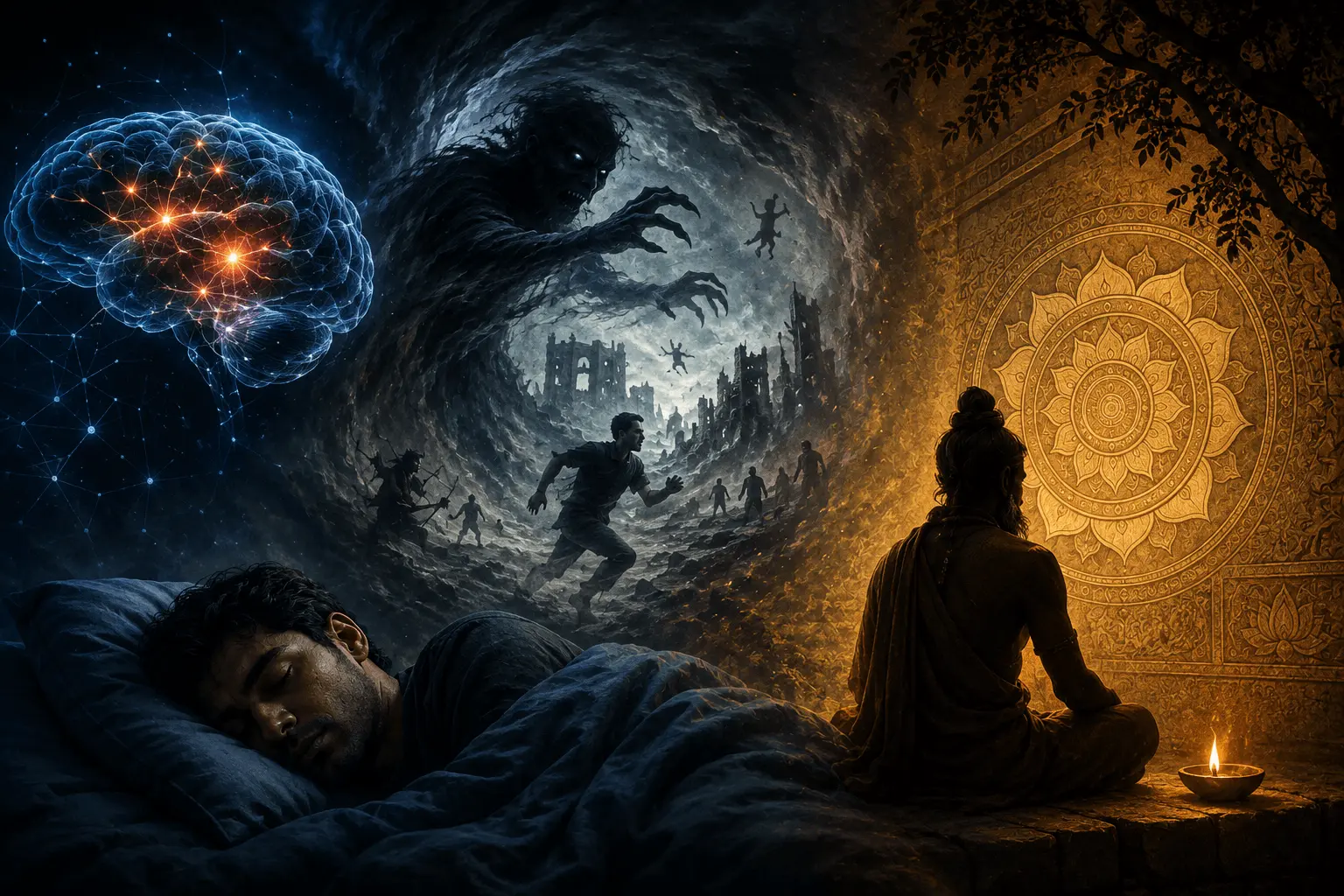
There is a particular kind of waking that feels like a minor act of survival.
You surface from sleep with your heart already racing. For a few seconds, the room seems unfamiliar. The darkness still contains the hallway you were running through, the animal that was chasing you, the person you could not save, the fall that never quite ended. Then the ordinary world returns: a ceiling, a pillow, the dim sounds of morning—or, if it is still night, the strange realization that you are safe.
But your nervous system may not know that yet.
A nightmare can leave behind a physical residue long after its story has disappeared. The pulse settles slowly. Muscles remain tense. A disturbing image keeps returning to consciousness. Sometimes the dream repeats for years, changing only its costumes.
Why would the sleeping brain create something so unpleasant?
One possibility is that frightening dreams are not simply the brain’s nighttime noise. In 2000, Finnish philosopher and cognitive neuroscientist Antti Revonsuo proposed the Threat Simulation Theory (TST): dreaming may have evolved, at least in part, as a biological system for simulating danger and rehearsing responses to it. In this view, the dream world becomes a kind of offline training environment—a place where an organism can encounter danger without directly facing it.
It is an elegant idea. It is also an idea that requires caution.
Dreams are notoriously difficult to study, and evidence for TST is mixed rather than conclusive. Some studies find striking concentrations of threatening material in dreams; others find too few realistic survival threats to support the theory's stronger evolutionary claims.
And long before modern neuroscience asked whether dreams rehearse danger, Indian traditions were asking a different question: What kind of experience is a dream, and what—if anything—should we do with it?
The answers found in the Vedic and post-Vedic traditions are not a scientific theory of dreaming. They belong to a different intellectual framework. The Māṇḍūkya Upaniṣad, for example, treats dreaming as a distinct mode of consciousness, while Vedic and classical Indian literature also contains traditions of auspicious, ominous, and protective dreams.
Putting these worlds side by side does not prove that one anticipated the other.
It does something more interesting: it reveals two very different ways of taking the nightmare seriously.
What exactly is a nightmare?
A frightening dream and a nightmare disorder are not automatically the same thing.
Nightmares are typically vivid, dysphoric dreams associated with awakening and relatively clear recall. Fear is common, although anger, disgust, helplessness, and other negative emotions can occur. They also differ from sleep terrors, which usually arise during non-REM sleep and involve much less detailed dream recall.
Occasional nightmares are part of ordinary human experience. They can become more frequent during periods of stress, emotional upheaval, trauma, sleep disruption, or psychiatric illness. Reviews estimate that recurrent nightmares affect a meaningful minority of adults, with substantially higher rates in some clinical populations. (Hasler & Germain, 2009, pp. 507-517)
The important point is that a nightmare is not simply a “bad dream.”
It is an experience in which the sleeping brain constructs a world that feels consequential enough to trigger intense emotion—sometimes even though the dreamer knows nothing about the real circumstances of the body lying safely in bed.
That apparent contradiction is exactly where the evolutionary question begins.
Revonsuo’s Threat Simulation Theory: what is the brain rehearsing?
The Threat Simulation Theory proposes that the dream world can function as a virtual environment for detecting and responding to threats.
Imagine an ancestral human encountering a predator. Survival would depend not only on recognizing danger but on rapidly selecting an appropriate response: run, hide, climb, fight, protect a child, find shelter.
Revonsuo proposes that dreaming may have provided an internal setting in which elements of such responses could be repeatedly activated without the physical cost of encountering the actual danger. Dreaming, on this account, would have acquired evolutionary value because simulated practice could potentially improve waking threat perception and avoidance.
Threat rehearsal in dreams
The theory makes several predictions.
If dreams have a threat-simulation function, we might expect:
- Threatening events to occur frequently in dreams.
- Threats to be disproportionately represented compared with ordinary waking experience.
- The dreamer to be the target of threats relatively often.
- Dreamers to attempt avoidance, escape, or defensive actions.
- Real-world exposure to danger or trauma to increase threatening dream material.
- Repeated exposure to simulated danger to have some adaptive value.
Some findings are surprisingly compatible with these predictions.
In one influential study of dreams from traumatized children, researchers reported more dreams and more threatening dream events among severely traumatized children than among less-traumatized or non-traumatized children. The threatening dreams also tended to contain more severe threats. (Valli et al., 2005, pp. 188-218)
Another study examining autobiographical sources found that dream threats were associated with threats and stress recorded in the preceding day. The findings also suggested that older threatening memories could contribute to dream threats when recent severe negative experiences were absent. (Lafrenière et al., 2018, pp. 124-135)
That is intriguing because it suggests that dreams may not simply replay yesterday.
They may recombine emotionally significant memories.
A frightening dream about being chased through an unfamiliar city may contain no literal event from waking life. Yet its emotional ingredients—danger, uncertainty, pursuit, inability to escape—may have roots in experiences accumulated across years.
Why would evolution favor nightmares?
At first glance, this is the hardest part of the theory.
If nightmares are adaptive, why do they feel so catastrophically bad?
TST answers that the unpleasantness is part of the simulation.
A threat that does not produce fear is a poor threat simulation. The physiological and emotional intensity of the dream is part of what makes the imagined danger salient.
There is an important distinction, however.
Threat simulation theory is primarily a theory about the possible evolutionary function of dreaming, not a claim that every nightmare is useful.
That distinction matters enormously.
A system can have an evolutionary history without every expression of that system being adaptive today. A capacity that may once have helped organisms respond to danger can also become excessive, dysregulated or maladaptive under modern conditions.
This becomes especially relevant in trauma-related nightmares.
A person with post-traumatic stress disorder may repeatedly dream about an assault, accident, combat experience or other traumatic event. Rather than producing mastery, the nightmare may intensify distress and fragment sleep. Modern research increasingly treats nightmares as part of a complex interaction among memory, emotional processing, arousal and sleep control, rather than assuming that every frightening dream is beneficial rehearsal.
The evolutionary argument in one glance
| Question | Threat Simulation Theory predicts | What the evidence suggests |
| Are threats common in dreams? | Yes | Some studies find substantial threat content |
| Are dream threats evolutionarily relevant? | Often | Some are, but many are socially or psychologically threatening rather than literal survival threats |
| Does waking danger affect dream threats? | Yes | Evidence supports an association |
| Do dreamers rehearse realistic escape responses? | Often | Evidence is mixed |
| Are nightmares necessarily adaptive? | Potentially | Not established; chronic nightmares can be clinically harmful |
| Does TST explain all dreaming? | No | It addresses a proposed function, especially threat-related dreaming |
The theory is therefore most accurately regarded as a testable evolutionary hypothesis, not a settled explanation of why humans dream.
The evidence for TST—and the problem with it
One reason TST continues to be influential is that it makes predictions that can, in principle, be tested.
Revonsuo and colleagues developed the Dream Threat Scale, a structured method for identifying threatening events in dream reports. Their research found substantial threat content and argued that dream threats were often more frequent than would be expected from ordinary waking experience. A later review concluded that several studies provided strong support for important predictions of TST.
But the theory has also faced an immediate empirical challenge.
Malcolm-Smith and colleagues analyzed dreams and reported that realistic survival threats were relatively uncommon. In their sample, fewer than 20% of dreams contained realistic survival threats, and actual escape from dream threats occurred in fewer than 2%. They argued that these data contradicted important predictions of TST.
Research on recurrent dreams produced an equally nuanced picture.
In a sample of 212 recurrent dreams, about 66% contained at least one threat, and dreamers frequently responded with defensive or evasive actions. Yet fewer than 15% portrayed realistic situations critical to physical survival or biological success, and successful escape was rare. (Zadra et al., 2006, pp. 450-463) The authors therefore concluded that the findings offered mixed support for TST.
That tension is important.
A nightmare about failing an examination, losing a relationship, being publicly humiliated, or arriving somewhere without clothes may be profoundly threatening to the dreamer without representing the kind of predator-prey scenario envisioned by a strict evolutionary interpretation.
The brain is likely simulating social threats as much as physical threats.
Dreams are incorporating waking concerns into a wider emotional simulation system.
Or perhaps threat simulation is one function among several rather than the master purpose of dreaming.
Current research does not permit us to choose among these possibilities with certainty.
Recurring nightmares: when the simulation refuses to end
A recurring nightmare is especially fascinating because repetition seems to contradict the idea of useful rehearsal.
If the brain is practicing a response, shouldn’t practice eventually improve the response?
Sometimes it does not.
Recurring nightmares can contain repeated themes—being chased, trapped, falling, failing, losing someone, being attacked—or repeated elements from a traumatic experience. Their persistence may reflect continuing emotional stress, acquired associations, trauma-related memory processes, or disturbed sleep control. The relationship is complex, and no single mechanism accounts for all recurrent nightmares.
This is where the modern clinical perspective becomes more useful than an overly neat evolutionary story.
The goal is not to interpret every nightmare as a message from an ancient survival system.
The goal is to understand when dreaming has become distressing, repetitive, and functionally disruptive.
One of the best-supported behavioral treatments is Imagery Rehearsal Therapy (IRT). In IRT, the person recalls the nightmare, deliberately changes its storyline or ending while awake, and rehearses the revised version. The American Academy of Sleep Medicine recommends IRT for nightmare disorder and PTSD-associated nightmares. (Casement & Swanson, 2012, pp. 566-574)
There is something conceptually striking here.
The nightmare is not treated by discovering its secret symbolic meaning.
It is treated by changing the brain’s learned relationship to the threatening narrative.
That is a very modern intervention for a very aged human experience.
A Vedic Perspective: Dreams, Protection and Ominous Signs
The Indian traditions require a different kind of reading.
It would be misleading to say that “the Vedas believed nightmares were threat simulations.” They did not formulate a neuroscience theory comparable to TST.
Nor is there one universally authoritative ancient text called Svapna Shastra that functions as the definitive Vedic doctrine of dreams.
Instead, ideas about dreams appear across several layers of Indian literature: Vedic hymns and ancillary texts, Upanishadic philosophy, Ayurveda, omen traditions and later dream-interpretation literature.
These sources should not be collapsed into a single doctrine.
The Upanishadic question is deeper than dream interpretation.
The Māṇḍūkya Upaniṣad gives the dream state a remarkably precise philosophical status.
It describes Taijasa as the second pāda, or “quarter,” of Ātman, whose field is the dream state and whose awareness is directed toward internal, subtle objects.
This is not a claim about REM physiology.
It is an inquiry into consciousness itself.
In the waking condition, experience appears oriented toward an external world through the senses. In dream, experience becomes internally generated yet can still appear immediate and convincing to the dreamer. The Upanishadic analysis uses this passage to investigate the relationship among consciousness, mind, appearance, and reality.
That produces an interesting conceptual parallel with contemporary neuroscience.
Neuroscience asks how the brain can construct a vivid world in the absence of ordinary external sensory input.
Vedānta asks what the existence of such an internally experienced world tells us regarding the nature of consciousness.
The questions overlap.
The answers are not the same.
The Vedic tradition also contains protective and ominous dream traditions.
Alongside philosophical investigation, Vedic literature contains a very different approach to troubling dreams.
The Atharvaveda, for example, contains hymns concerned specifically with evil or frightening dreams. One hymn invokes protection from the “evil dream”; another describes the removal or transfer of the harmful dream.
This is important because it demonstrates that ancient Indian traditions did not treat disturbing dreams merely as meaningless nighttime events.
They could be approached as experiences requiring ritual protection, purification or averting action.
The tradition is not identical to modern dream psychology.
It belongs to a ritual and metaphysical worldview in which dreams would participate in a larger network of auspiciousness, danger, health and destiny.
Later classical Indian medical literature develops this idea in considerably more detail.
The Suśruta Saṃhitā, for example, includes classifications of dreams regarded as auspicious or ominous in the context of health and prognosis. It also describes ritual responses to troubling dreams, including meditation on auspicious subjects and mantra practice.
The Caraka Saṃhitā likewise discusses certain ominous dreams as prognostic signs, specifically about illness.
Protective versus ominous dreams
| Traditional category | Traditional meaning | Important qualification |
| Protective / averting response | A disturbing dream may be ritually neutralized or counteracted | This is a religious-ritual framework, not a scientifically established mechanism |
| Ominous dream | Certain dream images may be interpreted as signs of danger, illness or misfortune | Classical texts often situate these interpretations within specific medical or ritual contexts |
| Auspicious dream | Certain images may signify favorable outcomes | Symbolic meanings vary across texts and traditions |
| Upanishadic dream | Dream is a mode of consciousness and an opportunity for philosophical inquiry | This is not primarily an omen dictionary |
| Modern clinical nightmare | A distressing dream associated with awakening and emotional suffering | Best understood through sleep medicine and psychological science |
This separation is essential.
A classical text saying that a particular dream was considered ominous is a historical fact about a traditional interpretive system.
It is not evidence that the dream predicts an actual future event.
That distinction permits us to respect the tradition without turning ancient symbolism into modern pseudoscience.
What happens when the two perspectives meet?
The most fruitful comparison between TST and Indian dream traditions may not be about prediction at all.
It may be about how humans respond to simulated danger.
Threat Simulation Theory proposes that the sleeping mind may construct threatening scenarios as part of an evolved biological function.
The Vedic and classical Indian traditions sometimes treat disturbing dreams as experiences that call for protection, discernment, ritual response, or philosophical reflection.
Neither framework calls for us to imagine that dreams are literally supernatural warnings.
And neither requires us to dismiss the emotional force of dreams.
The difference lies in the level of explanation.
Neuroscience asks:
How does the sleeping brain generate, regulate, and remember threatening experiences?
Evolutionary psychology asks:
Could simulated threat have provided an adaptive advantage?
Vedānta asks:
What does the dream state reveal about consciousness and the status of experience?
Traditional Svapna interpretation asks:
Does a particular dream carry symbolic, auspicious, or ominous significance within its cultural plus ritual framework?
These are not interchangeable questions.
They can, however, coexist.
A useful way to hold the whole subject together:
A nightmare can be biologically generated, psychologically meaningful, and culturally interpreted without any one of those descriptions automatically canceling the others.
What Can We Actually Say About Nightmares?
The safest scientific conclusion is also the most interesting.
Nightmares are not simply random noise—but science has not established one universal function for them.
Threat-related dreaming is common enough, and its relationship with waking stress and traumatic experience is strong enough, to make threat simulation an important hypothesis. Yet the evidence does not demonstrate that nightmares evolved specifically to train humans for physical survival.
Modern research increasingly points to a broader picture involving emotional memory, stress, threat perception, autobiographical material, REM sleep, arousal, and emotion regulation.
And the Vedic record adds a different insight: human beings have been observing, fearing, interpreting and ritualizing dreams for thousands of years.
The ancient question was not necessarily “What part of the brain generated this?”
It was often something closer to:
What does this experience mean, and how ought I respond to it?
That question remains surprisingly alive.
What You Can Do Tonight
If nightmares are occasional, the aim is not to become afraid of sleep. It is to create conditions that make healing sleep more likely.
1. Protect the last hour before bed
Keep the final part of the evening relatively quiet and predictable. Reduce stimulating screen use, intense work, and emotionally activating material close to bedtime.
This is practical sleep hygiene rather than a specifically Vedic recommendation.
2. Try a traditional calming practice
A few minutes of quiet meditation, gentle breath awareness, or prayer can serve as a consistent passage into sleep.
The scientific evidence does not establish that a particular mantra prevents nightmares. The traditional value lies in cultivating steadiness and reducing mental agitation before sleep.
3. Keep a dream journal—but write briefly
On waking, record the dream before reaching for your phone.
Note:
- the central emotion,
- the main threat,
- whether you escaped or responded,
- and anything emotionally significant from the previous day.
Do not assume that every symbol has a fixed meaning.
You are observing patterns, not decoding an oracle.
4. Get daylight
Regular exposure to daylight during the morning helps reinforce the body’s circadian timing. Sustaining a consistent sleep-wake schedule is one of the simplest foundations of healthy sleep.
5. If a nightmare repeats, rewrite it while awake
For a recurring nightmare, Imagery Rehearsal Therapy has clinical support. Write a modified version of the dream—one in which you escape, receive help, confront the danger, reach safety, or otherwise alter the threatening sequence—and rehearse the new version while awake. The American Academy of Sleep Medicine recommends IRT for nightmare disorder and PTSD-associated nightmares.
If nightmares are frequent, produce considerable distress, repeatedly wake you, or are connected with trauma, consider speaking with a qualified sleep or mental-health professional.
The Nightmare as a Meeting Place
Perhaps the most revealing thing about nightmares is that they sit at the intersection of several worlds.
They are neural events, because sleeping brains generate them.
They are emotional events, because fear can be experienced with extraordinary intensity during sleep.
They are memory events, because fragments of autobiographical experience often find their way into dream narratives.
They may have an evolutionary dimension, if threat simulation contributed to the survival value of dreaming.
And they have a long philosophical history, because Indian thinkers recognized the dream state as an unusual laboratory for investigating experience itself.
Revonsuo’s theory asks us to imagine the nightmare as a rehearsal room.
The Upanishadic tradition asks us to notice something more radical: the rehearsal room itself is an experience appearing in consciousness.
Neither observation tells us that every frightening dream has a hidden purpose.
Neither tells us that an ominous dream predicts the future.
But together they encourage a more mature attitude toward the sleeping mind.
The nightmare may be a failed simulation, an emotional echo, a memory under reconstruction, a stress response—or several of these at once.
And sometimes the most useful response is not to ask, “What does this dream predict?”
It is to ask:
What threat did my mind experience tonight—and what might help me feel safe when I wake?
Key Takeaways
- Threat Simulation Theory, proposed by Antti Revonsuo, suggests that dreaming may have an evolutionary function involving the simulation of threats and the rehearsal of avoidance responses.
- Some studies support TST by finding substantial threatening content and links between waking threat and dream threat.
- Other research challenges the theory because many dreams do not contain realistic survival threats and successful escape is relatively uncommon.
- Recurring nightmares can be associated with stress, trauma, psychiatric symptoms, and disturbed sleep; they should not automatically be regarded as adaptive rehearsals.
- The Māṇḍūkya Upaniṣad treats dreaming as Taijasa, a distinct mode of consciousness oriented toward internal, subtle objects.
- Vedic and classical Indian sources also contain traditions concerning evil dreams, auspicious dreams, omens and protective responses. Still, these belong to ritual, medical and traditional interpretive paradigms rather than modern empirical science.
- There is currently no scientific basis for claiming that an ominous dream reliably predicts a future event.
- For persistent nightmares, Imagery Rehearsal Therapy is an evidence-supported treatment.
References
Hasler, B. & Germain, A. (2009). Correlates and Treatments of Nightmares in Adults. Sleep Medicine Clinics 4(4), pp. 507-517. https://doi.org/10.1016/j.jsmc.2009.07.012
Valli, K., Revonsuo, A., Pälkäs, O., Ismail, K. H., Ali, K. J. & Punamäki, R. (2005). The threat simulation theory of the evolutionary function of dreaming: Evidence from dreams of traumatized children. Consciousness and Cognition 14(1), pp. 188-218. https://doi.org/10.1016/S1053-8100(03)00019-9
Lafrenière, A., Lortie-Lussier, M., Dale, A., Robidoux, R. & Koninck, J. D. (2018). Autobiographical memory sources of threats in dreams. Consciousness and Cognition 58, pp. 124-135. https://doi.org/10.1016/j.concog.2017.10.017
Zadra, A., Desjardins, S. & Marcotte, É. (2006). Evolutionary function of dreams: A test of the threat simulation theory in recurrent dreams. Consciousness and Cognition 15(2), pp. 450-463. https://doi.org/10.1016/j.concog.2005.02.002
Casement, M. D. & Swanson, L. M. (2012). A meta-analysis of imagery rehearsal for post-trauma nightmares: effects on nightmare frequency, sleep quality, and posttraumatic stress. Clinical Psychology Review 32(6), pp. 566-574. https://doi.org/10.1016/j.cpr.2012.06.002
0 Comments