
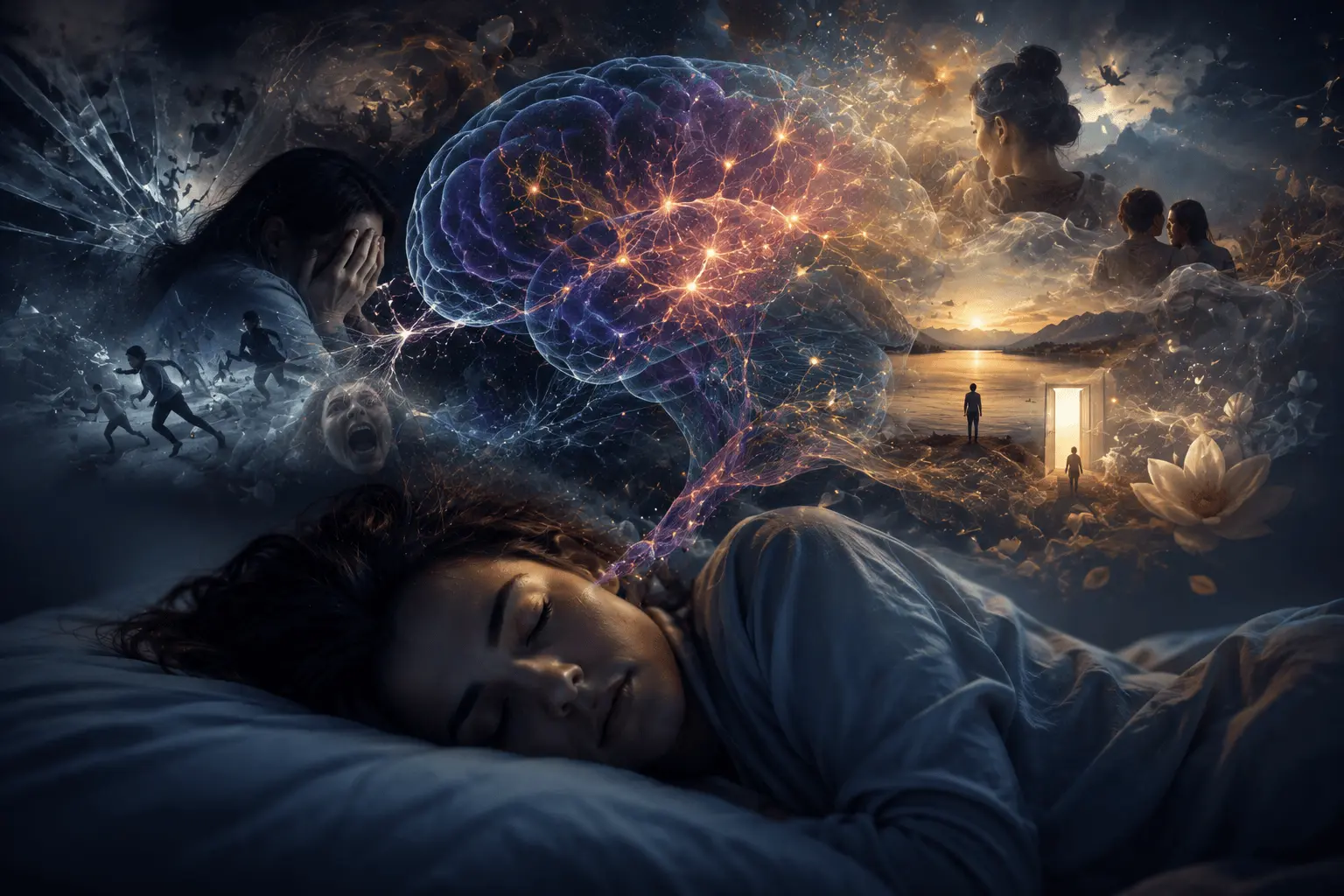
There is a strange moment after a difficult dream when the room is familiar again, the morning light is ordinary, and yet something inside you has not quite caught up.
You may wake with your heart beating fast after dreaming about a danger that no longer exists. Or you may dream about someone you have not thought about in years, only to discover that the feeling they left behind—grief, fear, longing, anger—is still remarkably vivid.
Sometimes the dream makes no obvious sense. A childhood home becomes a railway station. A colleague becomes a stranger. You are running, but never arriving. The plot dissolves within minutes of waking, while the emotion remains.
Why?
One of the most interesting possibilities in modern sleep science is that dreaming may be part of a larger overnight process in which the brain reworks emotionally significant memories. REM sleep, in particular, has attracted attention because its unusual neurochemistry creates conditions unlike those of ordinary waking consciousness.
But the story is subtler than the popular idea that the brain “processes emotions while we dream.” REM sleep is not a psychological filing cabinet, and science has not established that every dream serves a therapeutic purpose. What research does suggest is more interesting: sleep changes how emotional memories are consolidated, how fear is regulated, and how strongly we react to emotionally significant events the following day.
And here an unexpected conversation begins—with an ancient Indian understanding of svapna, the dream state.
The comparison is not an equation. The Upanishads were not describing REM physiology, and neuroscience cannot validate Vedantic metaphysics. Yet both traditions take seriously the peculiar fact that, during dreaming, the mind can construct an internally experienced world from material that is no longer coming directly from the external senses.
That meeting point gives us a fascinating question: what might the sleeping brain be doing with yesterday’s emotional life?
REM Sleep Is Not Simply “Dream Sleep”
Dreaming can occur during both REM and non-REM sleep, so it is inaccurate to treat REM as synonymous with dreaming. Nevertheless, REM sleep is strongly associated with vivid, immersive dream experiences and has distinctive brain chemistry.
During REM, activity in the locus coeruleus, a major source of noradrenaline in the brain, is markedly reduced. (Pal & Mallick, 2007, pp. 721-739) Noradrenaline—also called norepinephrine—is central to arousal, attention, vigilance and the body’s response to salient or threatening events.
That creates a remarkable neurochemical contrast.
During waking life, a frightening event can activate systems that increase vigilance and prepare us to respond. During REM, by contrast, the brain is highly active, while the noradrenergic system operates in a very different state.
Researchers have proposed that this combination may provide a useful environment for reprocessing emotional memories without reproducing the full waking neurochemical state in which those memories were originally encoded. (Feld & Born, 2020, pp. 31-44)
This is one reason REM sleep has become central to theories of emotional memory.
Science in context: REM sleep appears important for emotional processing, but researchers are still determining exactly which aspects of emotional memory depend on REM, which depend on other sleep stages, and which emerge from interactions across the entire night.
The distinction matters. Sleep is not one uniform state. NREM and REM sleep interact, and memory consolidation is distributed across multiple stages and neural systems.
So the most defensible statement is not that “REM removes bad emotions.” It appears that REM sleep participates in the overnight modification of emotional memories and emotional reactivity.
The Brain Does Not Need to Erase a Memory to Change Its Emotional Weight
Imagine that you receive frightening news at 3 p.m.
The event is encoded together with its emotional significance. Your brain remembers not only what happened, but also that it mattered.
Sleep does not necessarily delete that memory.
Instead, one possibility is that sleep helps separate aspects of the experience: the factual or contextual information may remain available while the intensity of the emotional response is modified.
This idea has been influential in research on sleep and emotional memory. Work reviewed by Matthew Walker and colleagues has proposed that sleep can support the consolidation of emotionally significant information while also altering subsequent emotional reactivity.
The amygdala, hippocampus and prefrontal cortex are particularly important in this discussion.
- The amygdala helps detect and learn about emotionally salient or threatening stimuli.
- The hippocampus contributes to contextual and episodic memory.
- The prefrontal cortex helps regulate emotional responses and place experiences into a broader context.
Sleep appears to influence communication among these systems.
The result may be less like “forgetting” and more like a change in the relationship between memory and alarm.
That distinction becomes crucial when we talk about fear.
Could REM Sleep Help the Brain Learn That the Danger Is Over?
Fear learning is adaptive. If a dog bites you, remembering dogs as potentially dangerous can protect you.
But the brain must also learn when the original danger is no longer present.
This is where fear extinction becomes important.
In laboratory research, extinction does not usually mean erasing the original fear memory. Instead, the brain learns a new association: this stimulus, in this context, is no longer predicting danger.
Sleep appears to participate in this process, although the precise contribution of REM sleep remains an active research question. Reviews of sleep and fear learning have found evidence linking sleep—particularly REM in some experimental paradigms—to the consolidation of fear and extinction memories.
A useful way to imagine it is:
| Emotional learning | Possible role of sleep |
| “This was dangerous.” | Consolidate important information |
| “This happened to me.” | Strengthen contextual memory |
| “It is dangerous everywhere.” | Potentially reduce inappropriate generalization |
| “It is safe now.” | Help consolidate extinction or safety learning |
| “I still need to react intensely.” | Emotional reactivity may remain elevated when sleep is disrupted |
The evidence is not uniform enough to say that REM sleep causes fear extinction in humans. Experimental methods vary considerably, and REM deprivation studies have produced mixed results.
A 2024 systematic review found accumulating evidence that REM disruption affects affective processing, but also emphasised substantial differences among experimental methods and a major gap in understanding chronic REM suppression in humans. (Pesonen et al., 2024)
In other words, the fascinating hypothesis is real; the final answer is not.
Why Noradrenaline Matters
Noradrenaline deserves special attention because it helps explain why REM sleep is biologically unusual.
During waking stress, noradrenergic activity supports vigilance. Your brain becomes biased toward detecting what might matter.
That is useful when a tiger—or a modern equivalent—is actually present.
It is less useful when the threat is gone, but the nervous system continues behaving as though danger is imminent.
Research into sleep and emotional brain function has proposed that REM sleep’s low noradrenergic environment may help recalibrate emotional salience networks involving the locus coeruleus, amygdala and prefrontal cortex. After adequate sleep, the brain may be better able to distinguish genuinely threatening information from emotionally neutral information. (Osorio-Forero et al., 2024)
This provides a plausible bridge between sleep quality and next-day emotional regulation.
After a poor night, small frustrations can feel disproportionately large. After restorative sleep, the same event may still be unpleasant without producing the same cascade of physiological alarm.
That does not mean REM is a nightly psychotherapy session.
It means that the sleeping brain changes the conditions under which emotional information is subsequently interpreted.
Waking Stress Can Enter the Dream
Anyone who has gone to bed worried knows that the boundary between waking emotion and dreaming is surprisingly porous.
A stressful day can produce dreams involving pursuit, failure, conflict, embarrassment, helplessness or loss. Yet dreams rarely reproduce waking life literally.
Your boss may become a schoolteacher. An argument may collapse like a building. A vague sense of insecurity may become a dream of being chased.
This makes dream content difficult to interpret scientifically.
Research does show that emotionally significant waking experiences can influence subsequent dreams, and threatening experiences may affect dream content after trauma. (Mathes et al., 2023) But there is no scientifically validated dictionary in which a particular dream symbol has one universal psychological meaning.
The Vedic perspective: Svapna as an inward world
The Bṛhadāraṇyaka Upaniṣad offers a strikingly different but conceptually interesting description of dreaming. In its discussion of svapna, the dream state is portrayed as an intermediate condition in which the dreamer encounters a world constructed from within. The text describes dream experience using images of creating chariots, roads and other objects rather than encountering them as ordinary external objects.
The Māṇḍūkya Upaniṣad gives the dream state a more precise philosophical role. It calls the dream experiencer Taijasa and characterises dream consciousness as oriented toward internal objects.
This is not an ancient version of modern neuroscience.
But it is a useful philosophical observation: dream experience is internally organised, yet subjectively convincing while it lasts.
That insight can sit alongside neuroscience without being confused with it.
Modern sleep research asks how the brain constructs and modifies experience during sleep. Vedanta asks a different question: what does the changing experience of waking, dreaming and deep sleep reveal about consciousness and the experiencer?
They are different investigations.
When Emotional Processing Becomes the Nightmare
If sleep contributes to emotional regulation, an obvious question follows:
Why do some people repeatedly dream about what frightens them?
Trauma provides one of the clearest examples.
Nightmares and disturbed sleep are common in post-traumatic stress disorder (PTSD). Trauma-related dreams may reproduce elements of the original event, but they can also become symbolic, fragmented or transformed. Importantly, trauma-related nightmares are not restricted to REM sleep, and research has not established one simple REM abnormality that explains all trauma-related dreaming. (Lancel et al., 2021)
This is where a popular interpretation of REM sleep needs correction.
If REM were simply a mechanism that “processes fear,” we might expect traumatic memories to become progressively less disturbing with repeated REM sleep.
That does not reliably happen.
Instead, trauma can disrupt the very sleep architecture and emotional regulation systems that researchers believe are important for adaptive processing. A 2025 systematic review found that REM disturbances, dysphoric dreams and nightmares occur across several conditions involving emotion dysregulation, with particularly substantial literature in PTSD. (Alvarez et al., 2025, pp. 1-15)
A newer 2026 review likewise describes trauma-related nightmares as part of a dynamic interaction among traumatic memories, emotional dysregulation, environmental triggers and sleep fragmentation rather than as a simple failure of one REM mechanism.
That is a more useful model.
Sometimes sleep may help emotional adaptation. Sometimes trauma may interfere with the conditions required for that adaptation.
Trauma Dreams Are Not Evidence That the Brain Is “Healing”
This distinction deserves emphasis.
A frightening dream after trauma does not necessarily mean that the brain is successfully processing the trauma.
Nor does a dream’s symbolic content provide a reliable diagnostic test for PTSD.
Researchers continue to investigate whether certain dream characteristics reflect memory consolidation, emotional processing, threat simulation, continued hyperarousal or combinations of these processes. Objective sleep findings in PTSD have also been inconsistent across studies.
For someone experiencing recurrent trauma nightmares, the practical priority is therefore not decoding every symbol.
It is restoring safe, stable sleep and addressing the underlying trauma with appropriate professional care.
Nightmares that are frequent, distressing or accompanied by significant daytime impairment deserve clinical attention.
Where the Science Is Strong—and Where It Is Still Uncertain
The field has moved considerably beyond the old idea that sleep is “off time” for the brain. Yet several popular claims about dreaming remain ahead of the evidence.
| Question | What current evidence supports | What remains uncertain |
|---|---|---|
| Does sleep affect emotional memory? | Yes; substantial evidence supports sleep-dependent emotional-memory processing. | Which mechanisms belong specifically to REM versus NREM |
| Is REM important for emotion? | Evidence increasingly points to an important role. | Exact causal mechanisms in humans |
| Does REM lower noradrenaline? | REM is characterized by markedly reduced noradrenergic activity. | How this translates into specific emotional outcomes |
| Does sleep support fear extinction? | Sleep appears relevant to fear and extinction memory. | Whether REM is consistently the decisive stage |
| Do dreams process trauma? | Trauma strongly affects sleep and dream experiences. | Whether particular dreams are themselves therapeutically necessary |
| Does dreaming reduce emotional distress? | Some models and experiments support this possibility. | It has not been established as a universal function of dreaming |
The scientific picture is therefore neither “dreams are meaningless” nor “dreams heal us.”
It is more nuanced:
Sleep changes memory. Sleep changes emotional reactivity. REM sleep is one important part of that process. Dreaming may accompany some of these processes, but the subjective dream itself cannot yet be equated with the underlying neurobiology.
What You Can Do Tonight
You do not need to manipulate REM sleep or interpret every dream to support healthy emotional processing.
1. Protect the second half of the night
REM periods generally become longer toward the later part of a typical night’s sleep. Regularly cutting sleep short may therefore reduce opportunities for later-night REM sleep.
Aim for a consistent sleep schedule and enough total sleep rather than trying to “optimise REM” separately.
2. Give your nervous system a gentler landing
For the final hour before bed, reduce stimulating work, emotionally charged conversations and intense screen use.
This is not a traditional Vedic prescription or a guaranteed REM intervention. It is simply a practical way to create conditions more compatible with winding down.
3. Try a brief calming practice
Slow breathing, quiet meditation, or yoga nidra can be used as a traditional contemplative practice to settle attention before sleep.
The important distinction is that these practices should not be presented as proven methods for increasing REM or “processing trauma overnight.” Their value may instead lie in reducing pre-sleep arousal and creating a calmer transition into sleep.
4. Keep a dream journal—but record before interpreting
On waking, write down whatever remains:
- the emotional tone
- people or places
- unusual images
- bodily sensations
- fragments of dialogue
- what happened immediately before waking
Do this before reaching for a dream dictionary.
Traditional dream interpretation and modern dream research are different activities. If you explore Svapna Shastra or Purāṇic dream traditions, treat their symbolic and omen-based frameworks as traditional systems of interpretation rather than experimentally validated psychological diagnostics. For example, the Agni Purāṇa contains a dedicated svapna-adhyāya concerning auspicious and inauspicious dreams and their traditional significance.
5. Look at patterns across mornings, not isolated symbols
One dream can be noise.
A recurring emotional pattern may be more informative.
Instead of asking, “What does dreaming of water mean?” ask:
“What feeling keeps returning?”
Fear? Shame? Loss? Helplessness? Conflict? Relief?
That question is psychologically more grounded and, in many cases, more useful.
The Deeper Lesson of the Dreaming Mind
Perhaps the most compelling insight lies not in deciding whether neuroscience or Vedanta has the “right” explanation, but in noticing what each discipline makes visible.
Neuroscience shows us a sleeping brain that is anything but inactive. Across the night, neural networks involved in memory, emotion, arousal and contextual learning change their patterns of communication. REM sleep, with its distinctive neurochemistry and low noradrenergic tone, appears to be one important setting in which emotional information is transformed.
Vedantic texts approach the dream from another direction.
The Māṇḍūkya Upaniṣad places svapna within a larger map of human experience: waking, dreaming, deep sleep and that which it calls the fourth, turīya. The purpose is not to explain REM physiology. It is to investigate consciousness itself.
The Bṛhadāraṇyaka Upaniṣad similarly treats the dream world as an internally generated field of experience—one in which the ordinary relationship between perceiver and external world is radically altered.
Modern science and these philosophical traditions therefore meet at an intriguing border, but they should not be collapsed into one another.
Science can measure REM density, autonomic activity, neural oscillations, memory performance and emotional reactivity.
Vedanta asks what it means that experience can change so profoundly while the sense of an experiencer remains through changing states.
One describes mechanisms.
The other investigates meaning and consciousness.
Neither needs to impersonate the other.
And perhaps that is the most honest way to understand the mysterious hours between falling asleep and waking again.
Your dreams may not be secret messages, prophecies or guaranteed emotional cures. But neither are they necessarily meaningless mental static.
They emerge from a brain actively reorganising its relationship with memory, emotion and the world.
Sometimes the result is absurd.
Sometimes beautiful.
Sometimes terrifying.
And occasionally, after a difficult night, you wake with the quiet sense that something has shifted—even if you cannot say exactly what.
Science is beginning to understand the biology behind that feeling.
The older contemplative traditions remind us that the mystery is larger still.
Key Takeaways
- REM sleep is strongly involved in emotional memory processing, although multiple sleep stages shape it.
- Noradrenaline falls sharply during REM, creating a distinctive neurochemical environment that may support emotional recalibration.
- Sleep appears to influence fear extinction, emotional reactivity and threat discrimination, but the precise contribution of REM remains under investigation.
- Stress and trauma can alter dreams and sleep, while recurrent nightmares may themselves contribute to sleep disruption and daytime distress.
- Trauma-related dreams should not automatically be interpreted as evidence that the brain is successfully “healing.”
- In the Māṇḍūkya Upaniṣad, svapna is the internally oriented dream state associated with Taijasa; this is a philosophical account of consciousness, not an ancient description of REM sleep.
- Traditional Svapna Shastra and Purāṇic dream interpretation should be distinguished from modern psychological and neuroscientific interpretation.
- The most evidence-aligned approach is to protect sleep, reduce excessive pre-sleep arousal, observe recurring emotional patterns and seek professional help when nightmares or trauma symptoms become persistent or impairing.
References
Pal, D. & Mallick, B. N. (2007). Neural mechanism of rapid eye movement sleep generation with reference to REM-OFF neurons in locus coeruleus. The Indian Journal of Medical Research 125(6), pp. 721-739. https://doi.org/10.4103/0971-5916.31407
Feld, G. B. & Born, J. (2020). Neurochemical mechanisms for memory processing during sleep: basic findings in humans and neuropsychiatric implications. Neuropsychopharmacology 45(1), pp. 31-44. https://doi.org/10.1038/s41386-019-0490-9
Pesonen, A., Koskinen, M., Vuorenhela, N., Halonen, R., Mäkituuri, S., Selin, M., Luokkala, S., Suutari, A. & Hovatta, I. (2024). The effect of REM-sleep disruption on affective processing: A systematic review of human and animal experimental studies. Neuroscience & Biobehavioral Reviews 162. https://doi.org/10.1016/j.neubiorev.2024.105714
Osorio-Forero, A., Foustoukos, G., Cardis, R., Cherrad, N., Devenoges, C., Fernandez, L. M. & Lüthi, A. (2024). Infraslow noradrenergic locus coeruleus activity fluctuations are gatekeepers of the NREM–REM sleep cycle. Nature Neuroscience 28. https://doi.org/10.1038/s41593-024-01822-0
Mathes, J., Schuffelen, J., Gieselmann, A. & Pietrowsky, R. (2023). Nightmare distress is related to traumatic childhood experiences, critical life events and emotional appraisal of a dream rather than to its content. Journal of Sleep Research 32(3). https://doi.org/10.1111/jsr.13779
Lancel, M. M., Marle, H. H., Veen, M. M. & Schagen, A. A. (2021). Disturbed Sleep in PTSD: Thinking Beyond Nightmares. Frontiers in Psychiatry 12. https://doi.org/10.3389/fpsyt.2021.767760
Alvarez, M. M., Balthasar, Y., Verbraecken, J., Claes, L., Leman, J., Verbraecken, J., Claes, L. & Leman, J. (2025). Systematic review: REM sleep, dysphoric dreams and nightmares as transdiagnostic features of psychiatric disorders with emotion dysregulation - Clinical implications. Sleep Medicine 127, pp. 1-15. https://doi.org/10.1016/j.sleep.2024.12.037
0 Comments