
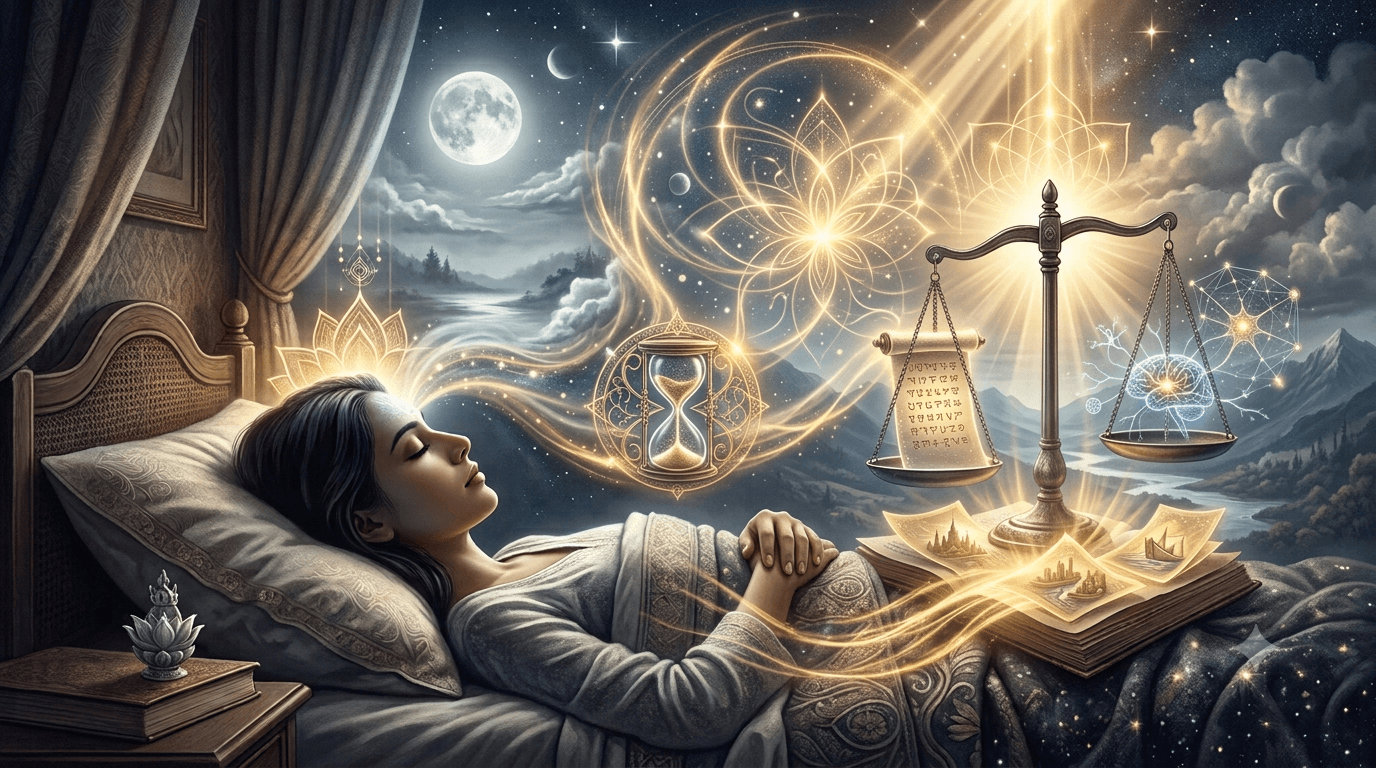
People have wondered about this for centuries. Most of us have woken up in the middle of the night after a vivid dream, maybe seeing a forest fire or flying through the clouds. Your heart pounds, and you might quickly look online or in a book for answers. Soon, you find all kinds of conflicting meanings: one source says a dream of fire means danger, while another says it means wealth.
Modern dream dictionaries often give set meanings to common symbols, but ancient Vedic texts take a different approach. Instead of asking what a symbol always means, they focus on what caused the dream in the first place.
Instead of seeing every dream as a mystical sign, classical Indian traditions say that dreams are shaped by our physical health and daily thoughts. This article uses that idea to help you distinguish between everyday mental chatter and dreams with deeper meaning.
Why Vedic Dream Interpretation Is Different
Unlike modern dream dictionaries that assign each symbol a single meaning, classical Vedic interpretation begins by identifying the source of the dream. For example, a dream about fire might represent a physical imbalance for one person but hold a symbolic meaning for someone else. The context, not just the symbol, is what matters most.
Classical texts such as the Atharvaveda-Pariśiṣṭa state that dreams are not random. They are closely linked to the mind-body connection. Based on this, the article outlines two simple steps to help you distinguish ordinary dreams from those with deeper meaning.
Step 1: Understand What Your Body Is Telling You (The Bio-Physical Context)
In the Ayurvedic tradition, every human body is governed by a unique mind-body constitution made up of three fundamental energies, or Doshas: Vata (air/movement), Pitta (fire/metabolism), and Kapha (earth/water).
When these elements shift or become unbalanced in your body, your mind turns that physical state into certain images while you sleep. Traditional texts call these symptomatic dreams.
Prakriti vs. Vikriti
To see how your body affects your dreams, it’s useful to know two key ideas from Ayurveda:
| Concept | Meaning |
| Prakriti | Your natural constitution, established at birth and relatively stable throughout life. |
| Vikriti | Your current state of balance or imbalance, influenced by factors such as diet, stress, sleep, illness, and seasonal changes. |
Common Dream Patterns and the Three Doshas
Dreams of Flying or Falling (Vata)
Have you ever dreamed of flying through the sky and then suddenly falling? Ayurveda says these dreams can occur when Vata, the dosha associated with movement and the nervous system, is out of balance. If you’ve been anxious, sleeping poorly, or feeling rushed, these dreams likely reflect your current state, not the future.
Dreams of Fire and Conflict (Pitta)
If you have too much Pitta (the fire element) right now, you might dream about burning forests, lightning, bright red or yellow colors, meteors, or intense arguments. Instead of predicting a crisis, these dreams usually show that your body’s heat, acidity, or inflammation is high.
Dreams of Water and Tranquility (Kapha)
When Kapha is strong and balanced, people often dream of calm lakes, white lotuses, snowy fields, or gentle rain. These images align with Kapha’s cool, steady nature and usually indicate that your body is in a stable state, not signaling about the future.
Key Takeaway - A dream about fire or water doesn’t always mean conflict or big changes are coming. Traditional Vedic interpretation says you should first look at your physical and mental state, since that’s usually where the meaning comes from.
Step 2: Ask Whether Your Mind Was Replaying the Day
Long before modern psychology studied the subconscious, classical Indian sages noticed that our daily experiences stay with us. Ancient texts call ordinary dreams Drishta (seen) or Anubhuta (experienced).
Imagine This Practical Example
Suppose you watch a suspenseful movie before bed. That night, you dream about being chased in a dark forest. The Atharvavedic tradition would regard this as a normal mental impression, not a prophecy, since it arises directly from a recent experience.
When you sleep, your subconscious keeps sorting through leftover thoughts, things you’ve seen or heard, and wishes you haven’t fulfilled. So if you’ve thought about something recently, traditional dream analysis sees the dream as a normal echo of your mind, not a sign of the future.
Ancient Wisdom and Modern Psychology
Modern neuroscience says dreams help us process emotions, store memories, and make sense of daily life while we sleep. Vedic dream interpretation uses a different philosophy, but both agree that most dreams come from our current inner state, not from future events.
When Does a Dream Become Spiritually Significant?
The Atharvaveda-Pariśiṣṭa says that a dream is considered meaningful or prophetic only if it can’t be linked to physical imbalances or recent memories. That’s why most dreams are seen as reflections of the present, not predictions of what’s to come.
How to Reflect on Your Dreams
Before you give your dream a special or symbolic meaning, try this traditional checklist to figure out where it came from:
- Was I under unusual physical or emotional stress yesterday?
- Did I recently watch, read, or hear something similar to the dream content?
- Have I been feeling ill, uncomfortably hot, or physically restless?
- Did I eat a heavy, spicy, or unusual meal close to bedtime?
- Have I been thinking about this specific subject repeatedly during the week?
- Does the dream imagery seem completely unrelated to my recent events and current health?
Common Misconceptions About Dreams
- Every vivid dream predicts the future: Most vivid dreams are actually intense reflections of emotional processing or physical changes in the body.
- Dream symbols have the same meaning for everyone: A symbol like fire holds entirely different meanings depending on a person's individual constitutional balance.
- Dreams should always be interpreted literally: Traditional systems look at the underlying elemental qualities (heat, movement, stability) rather than taking every scenario at face value.
- One generic dream dictionary can explain every dream: Context, timing, and personal health are required to understand any dream accurately.
Frequently Asked Questions
Can dreams predict the future?
According to classical traditions, the vast majority of dreams reflect physical health and recent memories. Only rare, specific dreams that pass the physical and psychological filters are considered potentially prophetic.
What does Ayurveda say about dreams?
Ayurveda views dreams as a diagnostic tool for the body. The imagery in your dreams often reflects the balance or imbalance of your three doshas: Vata, Pitta, and Kapha.
Why do I keep dreaming about fire?
Traditional dream interpretation suggests that frequent dreams of fire or heat may indicate an elevation in the Pitta dosha, which can be caused by stress, spicy foods, or physical inflammation.
Are recurring dreams meaningful?
Recurring dreams often indicate a prolonged emotional state, unresolved stress, or a continuous physical imbalance in the body that has not yet been addressed.
Conclusion
People everywhere have been fascinated by dreams for thousands of years. The Atharvaveda-Pariśiṣṭa teaches us to start with the present: before looking for future messages, first understand what’s happening now. By considering your health, emotions, and recent experiences, this traditional approach suggests that most dreams reflect your current state, while only a few call for deeper meaning.
Reference: अथर्ववेद-परिशिष्ट – The Pariśiṣṭas of the Atharvaveda (Omens related to Dreams).
0 Comments