
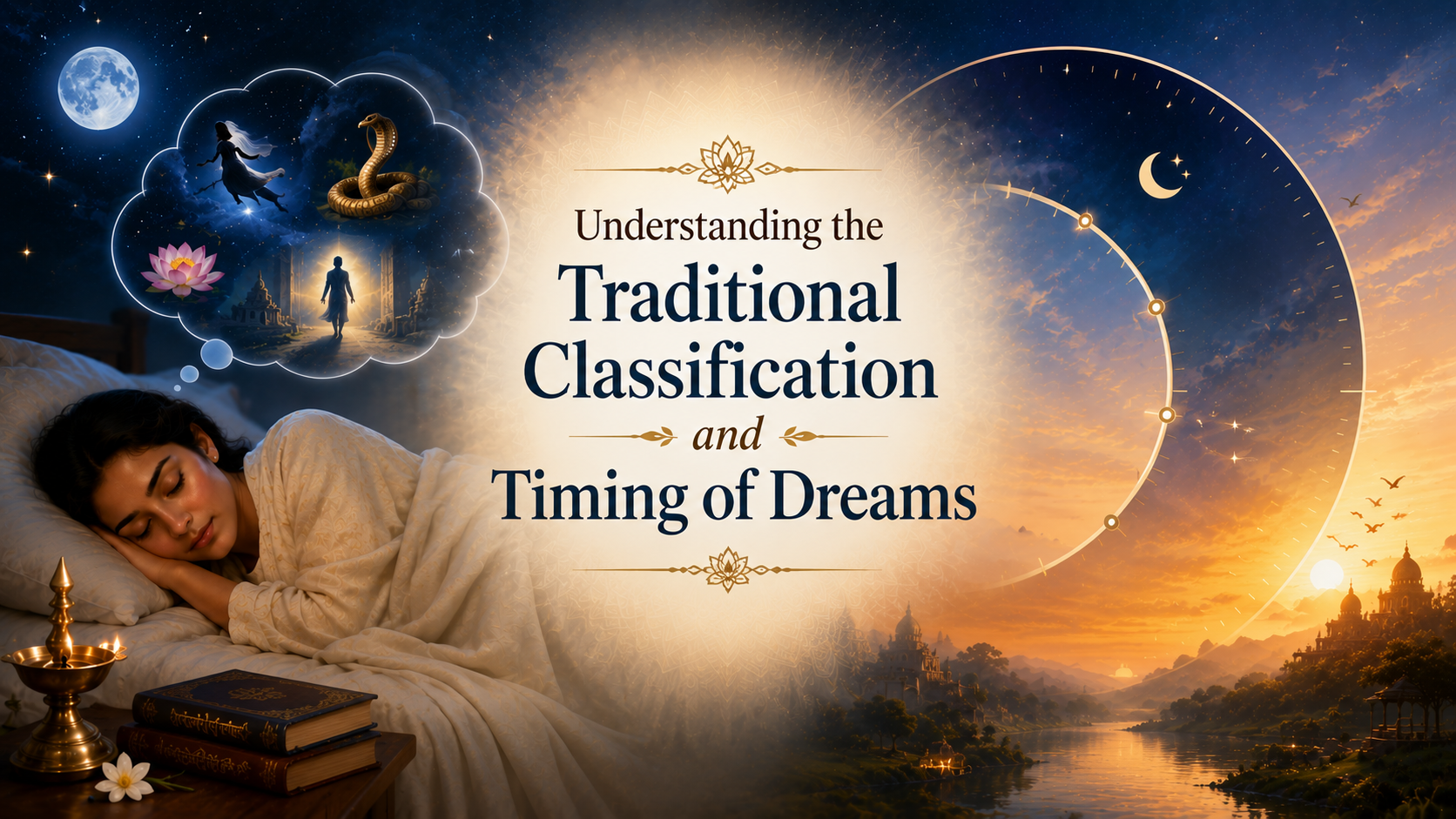
The Ancient View of Dreams and Their Meaning
In the Vedic tradition, dreams—known classically in Sanskrit as Svapna—are not merely random mental images arising during sleep. According to the timeless wisdom of Swapna Shastra (the ancient science of dream interpretation), dreams are subtle communications passing through different layers of human consciousness.
Vedic scriptures reveal that a dream's meaning is a precise spiritual equation. Its interpretation depends not only on what symbols are seen, but critically on the exact time at which they occur. Rather than treating all dreams as identical experiences, the traditional understanding places them in distinct categories, connecting them directly to cosmic signs, human experience, and karmic destiny.
The Four Traditional Types of Dreams
According to longstanding scriptural and spiritual understanding, dreams are generally grouped into four broad categories. Each type reflects a different nature, origin, and potential significance.
1. Indicative or Prophetic Dreams
Some dreams function as divine indicators of forthcoming life events or circumstances. Regarded as meaningful signs connected with future developments, these visions carry deep symbolic or predictive value and are sent as glimpses through the veil of time.
2. Auspicious Dreams (Shubha Swapna)
Auspicious dreams are associated with positive spiritual outcomes, divine blessings, and favorable worldly indications. Traditionally considered highly encouraging, these dreams are interpreted as signs linked with harmony, incoming prosperity, or beneficial spiritual growth.
3. Inauspicious Dreams (Ashubha Swapna)
In contrast, certain dreams are viewed as unfavorable, suggesting upcoming difficulty, energetic imbalance, or challenging experiences. In the Puranas, these are not meant to cause fear, but to act as a cosmic alert system so a person can perform neutralizing remedies (Pariharas).
4. Mixed Dreams (Mishra Swapna)
Not all dreams are entirely positive or negative. Mixed dreams contain overlapping elements that suggest both favorable and unfavorable implications. Their interpretation is highly nuanced, requiring careful discernment to separate the core message from background mental noise.
The Importance of Dream Timing (Praharas)
Traditional dream interpretation does not rely solely on dream content. Equal, if not greater, importance is placed on the specific period of the night—known as a Prahara (a traditional 3-hour time block)—during which a dream is experienced. The timing of a dream directly dictates the timeline within which its effects or indications may become apparent.
Dreams Seen in the Early Night (First Prahara)
A dream experienced during the first portion of the night, when the body is just entering deep rest, is traditionally believed to manifest its results over a long period, sometimes extending up to a full year.
Dreams Seen in the Progressing Night (Second, Third & Fourth Praharas)
As the night moves forward, the expected window for fulfillment rapidly shortens:
- Second Prahara: Dreams occurring during this phase are believed to show their results within several months (typically 3 to 6 months).
- Third Prahara: Visions seen during this phase are of much shorter duration, manifesting within a few weeks to 3 months.
- Fourth Prahara: Dreams experienced during the final portion of the night bear results quickly, often within a single month.
The Supreme Significance of the Pre-Dawn Period (Brahma Muhurta)
Particular importance is attached to dreams seen during the sacred pre-dawn hours, known as Brahma Muhurta (approximately 4:30 AM to 6:00 AM). This is a spiritually sensitive time when the atmosphere is pure (Sattvic), and the mind is closest to a state of divine alignment.
Traditional scriptural belief holds that dreams witnessed during this period reveal their consequences very swiftly, often within 1 to 10 days, or even the very same day. This understanding reflects the broader cultural view that the transition from night to sunrise is marked by unusual subtlety and spiritual clarity.
An even greater immediacy is associated with dreams experienced precisely at the threshold of sunrise, during the early morning moment when the world awakens, and daily activity begins. Such dreams are traditionally considered capable of producing immediate results.
Sharing Dreams for Divine Understanding
Traditional guidance strongly emphasizes that dreams should not remain entirely private when their meaning is heavy or uncertain.
Upon waking from a significant vision, it is advised to share it with a knowledgeable guide, a spiritually grounded mentor, or an experienced interpreter well-versed in Swapna Shastra. This practice reflects the ancient belief that proper decoding requires systematic wisdom and spiritual discernment rather than an impulsive, anxious conclusion.
Dreams in Traditional Thought
The traditional approach to dreams presents them as sacred experiences deserving quiet reflection rather than quick dismissal. By identifying the dream's category and the Prahara in which it arose, this perspective offers a structured, time-tested blueprint for navigating your life, drawing on ancient wisdom to find clarity in the modern world.
0 Comments