
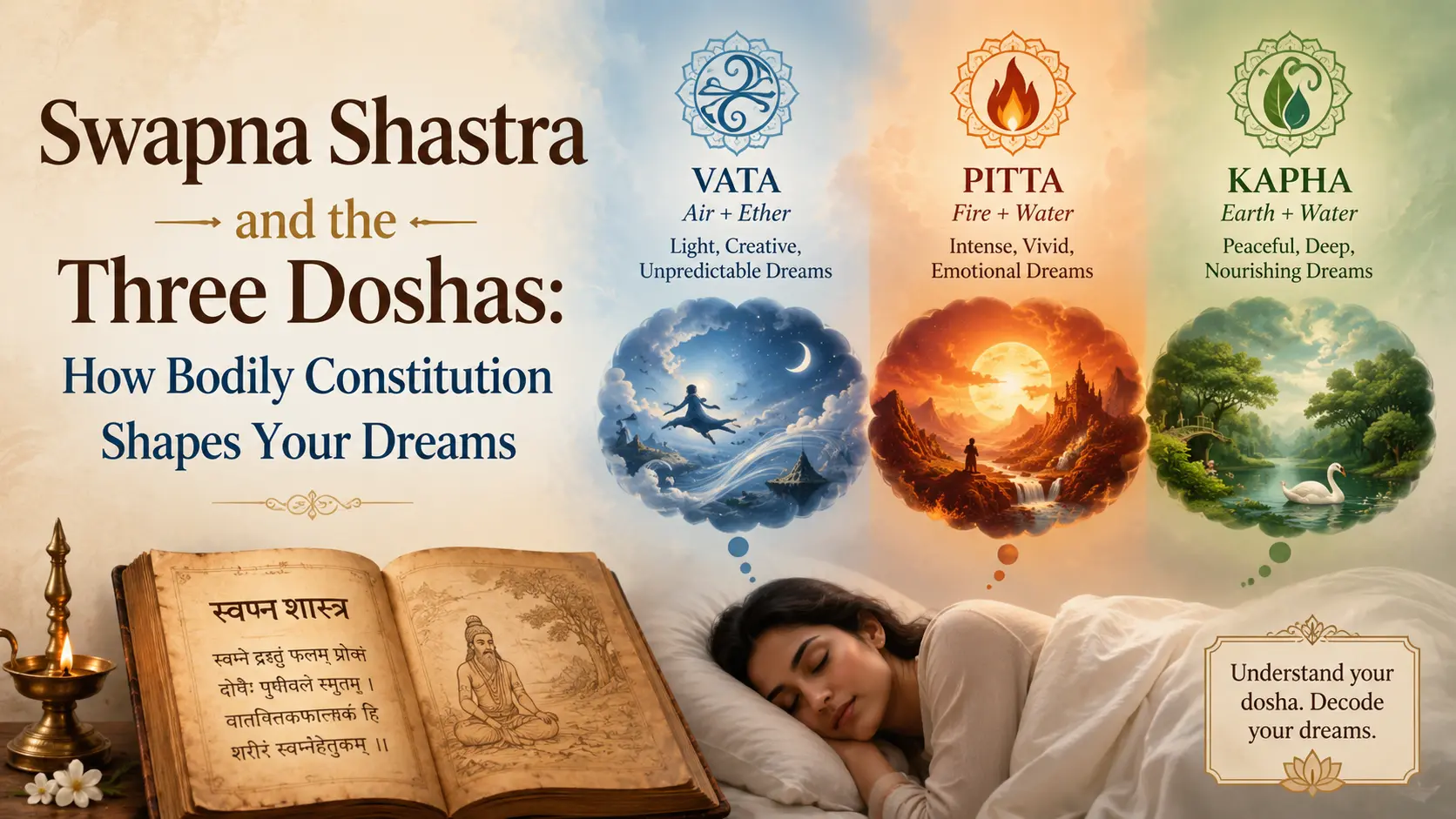
How Your Physical Nature Shapes Your Subtle Vision
The classical framework of Swapna Shastra establishes that a dream (Svapna) is never merely a product of floating mental imagination. Alongside subconscious memories and direct spiritual or karmic interventions, the biological condition of the physical body plays a foundational role in the architectural design of our nighttime visions.
In Vedic psychology, the mind and the physical tissue (Dhatus) exist in a continuous feedback loop. The biological humors—known as the Three Doshas (Vata, Pitta, and Kapha)—do not just dictate your metabolic health; their balance or systemic predominance directly scripts the exact landscapes, colors, and textures that cross your consciousness during sleep. Therefore, dreams function as an internal diagnostic mirror, exposing your current state of health and energetic equilibrium.
1. Dreams Associated with Kapha Dominance (Sleshma Swapna)
When an individual's constitution features a natural predominance of Kapha (the water and earth elements), or when Kapha becomes elevated within the physiology, dreams take on a distinctively calm, cooling, and opulent character. The dreamscapes are heavily adorned with imagery of fluid abundance, soft textures, and serene natural beauty.
Common Dream Motifs Linked with Kapha:
- Tranquil Waters: Vast expanses of pristine oceans, deep lakes, or wide rivers marked by a smooth, full, and steady flow.
- Sacred Aquatic Flora: Majestic wetlands filled with blooming lotuses, swans, and peaceful water birds.
- Crystalline Architecture: Radiant palaces, ivory towers, and bright, clean enclosed spaces that glow with an internal, pearlescent light.
- Celestial Displays: Dreamscapes bathed in the soft glow of a full moon, clear starlight, or gentle, moisture-rich gathering rain clouds.
The emotional atmosphere of a Kapha-dominant dream is inherently nourishing, comforting, and deeply refined. Traditional texts frequently note that these dreamers experience pleasant tastes, grand ritual feasts, and auspicious temple environments.
Symbols of Divine Grace and Purity
Kapha dream imagery is highly tied to classical aesthetics and harmonious companionship. The figures who populate these dreams appear graceful, elegantly adorned, and enveloped in a soft radiance. Recurring motifs include pristine white garments, fresh flower garlands, and gentle auric fields. In Swapna Shastra, these are classified as highly auspicious reflections of the stabilizing, grounding qualities of a healthy, balanced Kapha humor.
2. Dreams Born from Pitta Predominance (Tejas Swapna)
In stark contrast to the soothing stillness of Kapha, dreams influenced by a predominance or aggravation of the Pitta Dosha (the fire and acid elements) are defined by intensity, sharp focus, and violent sensory data. The dream world forged by Pitta is exceptionally vivid and highly energetic, often carrying dramatic, confrontational symbolism.
Characteristic Imagery of Pitta Dreams:
- Consuming Elements: Blazing forest fires, erupting volcanoes, or structural infernos crackling with heat.
- Blinding Light: Explosive lightning strikes, blinding solar glares, or brilliant flashes of colored light (specifically golden, deep yellow, or crimson hues).
- Sharp Instruments: Imagery involving knives, spears, arrows, or geometric surroundings defined by sharp angles and cutting edges.
- Climatic Overheating: Wandering through parched deserts, burning landscapes, or finding oneself trapped in humid, sweltering rooms.
The psychological backdrop of a Pitta dream tends to be aggressive, urgent, and penetrating. Dreamers often wake with their hearts racing, having experienced internal narratives centered around arguments, combat, or urgent deadlines. Furthermore, because an overactive Pitta disrupts internal equilibrium, it frequently generates sensations of falling, structural collapses, or sudden impacts.
Interestingly, despite the fiery themes, a severe biological thirst or an obsessive search for water is a textbook Pitta dream marker, reflecting the physical body's subconscious plea to cool its internal inflammation.
3. Dreams Arising from Vata Predominance (Vayu Swapna)
The Vata Dosha (composed of the air and ether elements) generates a dream landscape entirely different from the others. Vata is defined by erratic movement, lightness, coldness, and perpetual change. When Vata is the dominant force in the body or becomes aggravated by stress and exhaustion, it projects these exact restless qualities directly onto the mind's screen.
Traditional Indicators of Vata Dreams:
- Ascending to Altitudes: Constantly climbing steep mountains, scaling treacherous cliffs, or standing atop high, narrow ledges.
- Atmospheric Motion: Walking through desolate valleys while giant, ancient trees sway violently under the force of howling winds.
- Erratic, High-Speed Travel: Racing in out-of-control vehicles, riding fast-moving animals, or fleeing from unseen pursuers.
- Flight and Levitation: Experiencing the distinct sensation of flying through the air, floating above buildings, or drifting through the open sky.
Unlike the heavy, grounded imagery of Kapha or the focused, burning intensity of Pitta, Vata dreams are a chaotic blur of movement and transition. The dreamer frequently shifts locations instantly without logical transition, experiences unstable or crumbling terrain, and struggles with an underlying undercurrent of coldness, isolation, or generalized anxiety. This directly mirrors the light, dry, and unstable properties of an overactive air element.
Dreams as a Tool for Self-Diagnosis and Balance
Ancient Vedic dream interpretation never treats these patterns as random or universal anomalies. Instead, Swapna Shastra views your dream history as a highly personalized, subtle diagnostic report of your biological system.
Elements like water, fire, flight, color saturation, and emotional pacing are not merely abstract psychological symbols; they are direct diagnostic communications from your body's constitutional ecosystem.
| Dosha Type | Primary Elements | Core Dream Environments | Predominant Dream Emotions |
|---|---|---|---|
| Kapha | Water & Earth | Lakes, Lotuses, Temples, Moonlit Valleys | Serenity, Joy, Abundance, Peace |
| Pitta | Fire & Water | Lightnings, Fires, Battles, Hot Deserts | Urgency, Anger, Conflict, Alarm |
| Vata | Air & Ether | Sky, Cliffs, Flight, Wind-swept Wastelands | Restlessness, Disorientation, Fear |
By paying close attention to your recurring dream motifs, you can identify which of your internal Doshas is accumulating or entering a state of imbalance long before physical symptoms manifest in your waking life.
A Unified View of Mind, Body, and Spirit
The intricate marriage between your physical constitution and your subconscious imagery highlights the profound holism of the Vedic tradition. The mind, the spirit, and the body are not separate compartments; they are interconnected expressions of a single, continuous consciousness.
Approached through this lens, your dreams cease to be meaningless illusions. They transform into a sophisticated, time-tested language of self-awareness—an invitation from your inner self to observe, understand, and restore harmony to your entire natural state of being.
0 Comments