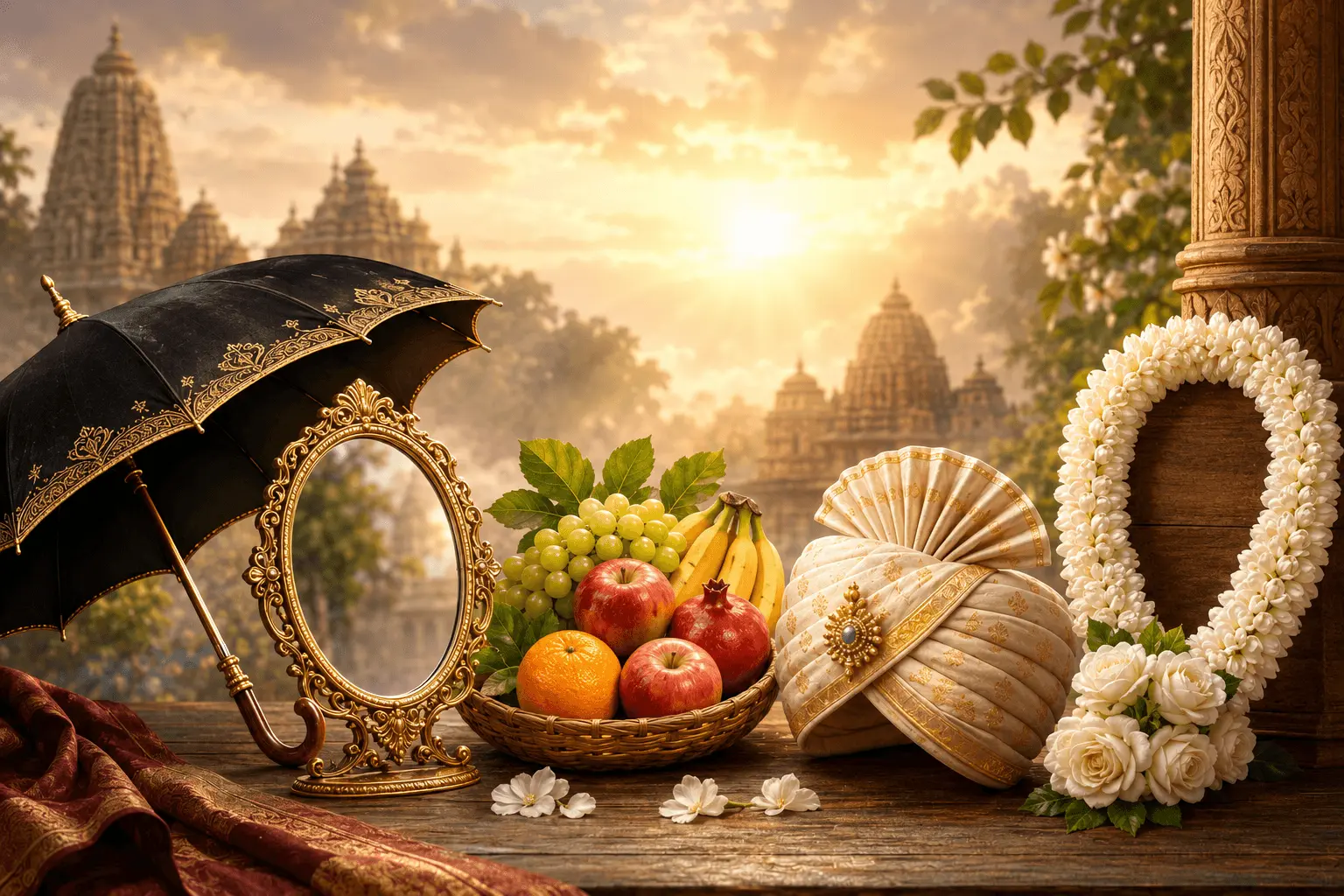
Dream customs often preserve meanings in remarkably concise forms. A single object appearing in a dream may be treated as an omen, with its significance determined not by modern psychological theories but by the traditional framework. The material provided from The Pariśiṣṭas of the Atharvaveda offers one such concise interpretation: the arrival or acquisition of an umbrella, mirror, fruit, turban, or white garland is associated with very great happiness.
This interpretation is notable because of its simplicity. The source does not attach separate numerical predictions, time periods, financial amounts, health outcomes, marriage predictions, or other specific worldly events to these objects. Instead, it gives a broad but strongly favorable result: very great happiness.
That distinction matters when interpreting classical dream material. A responsible reading should preserve what the traditional text actually says rather than filling its silences with modern assumptions or unrelated symbolic systems.
At the same time, each object carries its own identity within the dream. An umbrella is not a mirror, a mirror is not fruit, and a white garland is not simply a generic garland. The conditions described in the source—particularly the arrival or acquisition of the object and, in the case of the garland, its white color—form part of the interpretation.
According to the traditional source, the arrival or acquisition of these objects is regarded as a favorable dream sign associated with very great happiness.
Vedic & Adhyatmik Interpretation
The Central Traditional Prediction
The central point in the supplied material is clear: the arrival or acquisition of an umbrella, mirror, fruit, turban, or white garland is associated with very great happiness.
This should remain the primary interpretation.
The wording also establishes an important condition. The source is not simply discussing the abstract presence of these objects. It refers to their arrival or acquisition. Therefore, an interpretation faithful to the source should retain that condition rather than reducing the meaning to simply “seeing an umbrella,” “seeing a mirror,” or “seeing fruit.”
The five dream symbols can be understood individually while remaining within the same overall traditional prediction:
| Dream symbol | Qualifying condition | Traditional interpretation |
| Umbrella | Arrival or acquisition | Very great happiness |
| Mirror | Arrival or acquisition | Very great happiness |
| Fruit | Arrival or acquisition | Very great happiness |
| Turban | Arrival or acquisition | Very great happiness |
| White garland | Arrival or acquisition | Very great happiness |
The table makes the source’s structure evident: the objects differ, but the traditional result given for them is the same.
Why the Dream Condition Matters
Classical dream interpretation frequently depends on details surrounding an object. In the material provided here, the relevant condition is arrival or acquisition.
That means the dream should be understood in light of the complete event described by the source. The focus is not simply on the visual appearance of an object but on its coming to the dreamer or being acquired by the dreamer.
This is an important distinction for readers searching for the meaning of a particular dream. Someone who dreams of receiving an umbrella is inquiring about a more specific traditional omen than someone who merely notices an umbrella somewhere in a dream.
Similarly, the source specifically identifies a white garland, so the color should not be removed when discussing that symbol.
Five Favorable Dream Symbols
1. Dream of Receiving or Acquiring an Umbrella
The umbrella is the first object identified in the source. Its arrival or acquisition in a dream is associated with very great happiness.
The interpretation should remain close to this explicit prediction. The supplied material does not state that the umbrella predicts wealth, protection, professional advancement, marriage, victory, or any other particular event. Those meanings may exist in other cultural settings, but they should not be presented as though they came from this specific source.
The traditional reading is therefore straightforward:
If an umbrella arrives or is acquired in the dream, the stated omen is very great happiness.
The simplicity of this interpretation is itself significant. There is no numerical measure attached to the happiness and no specified period in which it must occur. The source characterizes the outcome as very great happiness.
For readers approaching the dream from a Vedic or traditional perspective, this makes the umbrella a favorable dream symbol, provided the dream corresponds to the condition described in the source.
2. Dream of Receiving or Acquiring a Mirror
The second symbol is the mirror. According to the provided material, the arrival or acquisition of a mirror is likewise associated with very great happiness.
It is tempting to expand the meaning of a mirror by drawing on modern symbolic associations—self-image, identity, introspection, or psychological self-awareness. However, those interpretations are not supplied by the source and should not replace the traditional prediction.
For this particular article, the most faithful interpretation remains the classical one:
The arrival or acquisition of a mirror in a dream is traditionally associated with very great happiness.
The mirror therefore belongs to the same favorable category as the other objects listed in the source. Its interpretation should not be weakened into a vague statement such as “the dream may represent positive change.” The first prediction is more definite: very great happiness.
At the same time, it should not be exaggerated into a prediction of a specific event that the source does not name.
3. Dream of Receiving or Acquiring Fruit
Fruit is the third dream object included in the passage. The source associates its arrival or acquisition with very great happiness.
Here again, accuracy requires resisting the temptation to add meanings that are not present in the supplied material.
The source does not identify a particular fruit. It does not distinguish between varieties, colors, quantities, ripeness, or methods of receiving the fruit. It simply identifies the fruit and links its arrival or acquisition to the stated favorable result.
Accordingly, the traditional interpretation can be expressed plainly:
Receiving or acquiring fruit in a dream is associated with very great happiness.
This is also why the dream should not automatically be interpreted through a separate system of fertility, abundance, nourishment, prosperity, or material success. Such concepts may occur elsewhere in traditional symbolism, but they are not stated in the source passage provided for this interpretation.
The strongest editorial approach is therefore to preserve the exact traditional prediction rather than expanding it beyond its textual foundation.
4. Dream of Receiving or Acquiring a Turban
The fourth object is the turban. The provided source places the arrival or acquisition of a turban within the same favorable category and associates it with very great happiness.
A turban can carry substantial cultural meaning in different historical and regional contexts. It may be associated elsewhere with dignity, authority, social position, identity, ceremony, or honor. But those broader associations should not be confused with the specific prediction contained in the source.
The source provided here yields a single clear result.
The arrival or acquisition of a turban in a dream is traditionally associated with very great happiness.
This wording also preserves the distinction between the object itself and the condition under which it appears. The focus is on the turban arriving or being acquired, not simply on seeing one in the dream.
For readers interested in classical dream interpretation, that distinction helps prevent overgeneralization. The traditional omen should be read according to the complete description supplied by the text.
5. Dream of Receiving or Acquiring a White Garland
The fifth symbol is the white garland. This dream requires particular attention to its qualifier because the source does not simply mention a garland. It specifically refers to a white garland.
Its arrival or acquisition is associated with very great happiness.
The color should therefore remain part of the dream symbol. An article about this specific omen should not silently transform “white garland” into “garland” because doing so would remove information supplied by the primary text.
The traditional interpretation is:
The arrival or acquisition of a white garland in a dream is associated with very great happiness.
The source does not specify whether this happiness pertains to a ceremony, a relationship, a spiritual event, social recognition, or material gain. It would therefore be inappropriate to attach one of those outcomes to the dream without textual support.
The strongest interpretation remains the simplest: a white garland arriving or being acquired in the dream is a favorable omen of very great happiness.
What These Five Dreams Have in Common
Although the five objects are different, the supplied source gives them a common traditional outcome. An umbrella, mirror, fruit, turban, and white garland are each connected with very great happiness when they arrive or are acquired in the dream.
This shared interpretation is worth emphasizing because it prevents unnecessary fragmentation of the source.
The objects should still be treated as distinct dream symbols. Their individual identities matter, especially for readers searching for the meaning of one particular dream. Yet they can be discussed together because the source assigns the same explicit outcome to each.
The common pattern is therefore:
Object + arrival or acquisition = very great happiness
That is the central interpretive structure preserved by the source.
Traditional Prediction vs. Broader Symbolic Meaning
Traditional Prediction
The traditional prediction is the most important part of the interpretation:
The arrival or acquisition of an umbrella, mirror, fruit, turban, or white garland is associated with very great happiness.
This statement should not be weakened into an uncertain psychological suggestion. At the same time, it should not be strengthened into a prediction that the source does not make.
The source says very great happiness. It does not say:
- A specific amount of money
- A promotion
- Marriage
- Childbirth
- Victory
- Recovery from illness
- A particular number of days
- A particular number of months
- A specific material possession
None of those outcomes should therefore be presented as part of this particular interpretation.
Symbolic Understanding
A wider cultural discussion may assign different symbolic associations to umbrellas, mirrors, fruit, turbans, or white garlands. However, those associations fall within a larger field of cultural interpretation and should not override the explicit predictions of the supplied classical material.
For this reason, the article maintains a clear hierarchy:
Classical textual meaning comes first.
Wider cultural associations can provide context, but they should never replace the direct interpretation preserved in the source.
Why the Qualifiers Should Be Preserved
One of the most important principles in interpreting traditional dream material is to preserve conditions that form part of the omen.
In this passage, the relevant qualifier is "arrival" or "acquisition".
For example, the source-supported title is more accurately expressed as:
Dream of Receiving or Acquiring an Umbrella
rather than simply:
Dream of an Umbrella
Likewise:
Dream of Receiving or Acquiring a Mirror
is more faithful than simply “Mirror Dream.”
The same principle applies to fruit and the turban. In the case of the garland, there is an additional qualifier:
white garland
Removing that adjective would reduce the specificity of the first dream symbol.
This approach matters because classical dream interpretations frequently depend on exact circumstances. An object, its condition, its location, its sequence, or the action involving it can form part of the omen. The source provided here gives us one such condition, and it should be retained throughout the interpretation.
What the Source Does Not Say
A responsible editorial article should also identify the limits of the available material.
The supplied passage does not provide:
- A precise time when the predicted happiness will occur
- A numerical value for the happiness
- A specific worldly event that will cause it
- A distinction between different types of happiness
- A separate interpretation based on the dreamer’s age or circumstances
- A separate interpretation based on the location of the dream
- A psychological explanation
- A modern scientific explanation
Because these details are absent, they should not be invented.
This is especially important when presenting traditional dream interpretation online. Readers may encounter many competing interpretations, but a source-based article should distinguish clearly between what the classical material actually states and what later traditions or modern commentators might infer.
A Balanced Way to Read These Dreams
Traditional dream interpretation should not be confused with a scientifically established prediction of future events. The material discussed here belongs to a traditional cultural and spiritual framework.
Within that framework, however, the prediction is clear: the arrival or acquisition of the listed objects is associated with very great happiness.
A balanced reading therefore holds two ideas together.
First, the traditional meaning should be preserved accurately. There is no reason to dilute the explicit favorable interpretation into a broad statement about “positive energy” when the source itself gives a stronger and more specific outcome.
Second, readers should avoid extending the prediction beyond the evidence. A favorable dream omen does not automatically tell us exactly what form happiness will take or when it will appear.
The value of preserving the traditional interpretation consists in understanding what the text says on its own terms.
Frequently Asked Questions
What does it mean to dream of receiving an umbrella?
According to the supplied traditional material, the arrival or acquisition of an umbrella is associated with very great happiness.
What is the traditional meaning of receiving a mirror in a dream?
The source associates the arrival or acquisition of a mirror with very great happiness. It does not offer a more specific prediction.
Is dreaming of receiving fruit considered favorable?
Yes. In the traditional interpretation provided, the arrival or acquisition of fruit is associated with great happiness.
What does acquiring a turban in a dream mean?
The traditional interpretation provided associates the arrival or acquisition of a turban with very great happiness.
What does a white garland mean in a dream?
The source specifically refers to the arrival or acquisition of a white garland and associates this with very great happiness. The white qualifier should be retained when interpreting the symbol.
Are these dreams considered auspicious?
Within the traditional framework of the supplied source, yes. The listed dream conditions are associated with very great happiness, making them favorable omens in that framework.
Does the source predict wealth or money from these dreams?
Not in the supplied passage. The explicit prediction is very great happiness. A specific financial prediction should not be added without supporting textual evidence.
Does the source give a time period for the happiness?
No. The provided passage does not specify a numerical or chronological period during which the predicted happiness will manifest.
Conclusion
The traditional dream material in The Pariśiṣṭas of the Atharvaveda presents a clear and favorable interpretation of five distinct dream symbols: an umbrella, a mirror, fruit, a turban, and a white garland. When these objects arrive or are acquired in the dream, the stated traditional outcome is very great happiness.
Each symbol should retain its own identity. The umbrella should remain an umbrella; the mirror should remain a mirror; fruit should not be transformed into a wider idea of abundance; the turban should not automatically become a prediction of status; and the white garland should retain its important color qualifier.
At the same time, the five symbols share the same explicit traditional prediction. This makes the passage notable for its consistency: different dream objects are presented under one favorable outcome—very great happiness.
The most faithful interpretation is therefore neither an exaggerated prophecy nor a vague modern metaphor. It is the direct traditional meaning preserved in the source:
The arrival or acquisition of an umbrella, mirror, fruit, turban, or white garland in a dream is regarded as an omen of very great happiness.
For readers approaching these dreams from a traditional perspective, that is the central message to preserve. For readers approaching them from a modern perspective, the interpretation can be appreciated as part of the historical and cultural tradition of South Asian dream symbolism, without presenting the traditional prediction as a scientific fact.
Reference: The Pariśiṣṭas of the Atharvaveda
0 Comments