
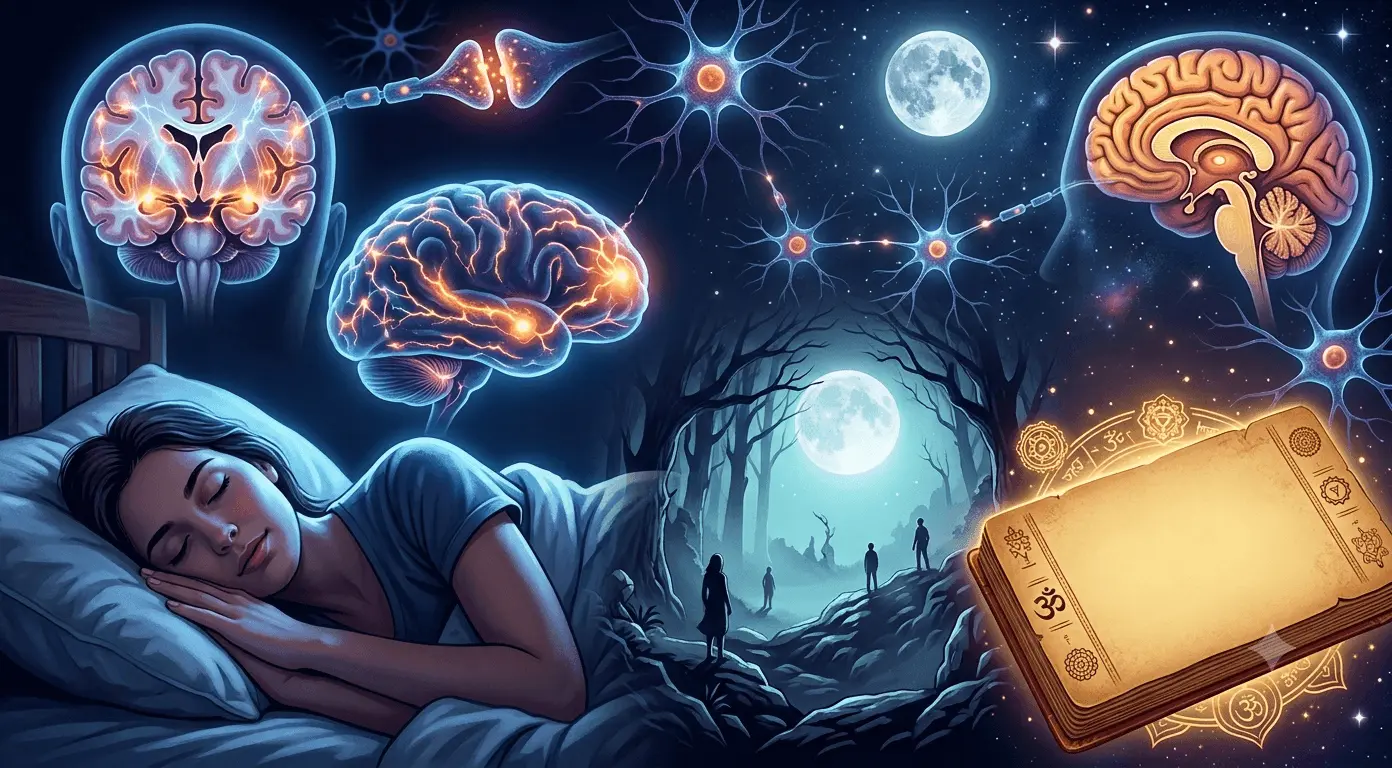
Imagine standing at the edge of a cliff with the wind blowing around you. One step and you’re falling into darkness. Or maybe you’re running through a dark forest, chased by something unseen. If this happened while you were awake, your heart would pound, your muscles would tense, and you’d want to get away.
But when you dream, things work differently.
Dreams can feel real, but your brain treats them differently than waking events. Instead of causing a strong fight-or-flight response, your brain uses sleep as a safer way to work through emotional memories. Instead of just repeating fear, your brain may help you change how you respond to it.
This difference is one of the most fascinating discoveries in modern sleep science.
Scientists have discovered that during REM sleep, when dreams are most vivid, the brain lowers levels of noradrenaline (also called norepinephrine), a key stress chemical. This lets you revisit emotional experiences without feeling as much stress as you would when awake.
Vedic philosophy shares a similar view. Traditional teachings describe Svapna Avastha, the dream state, as a place where memories and impressions (Samskaras) become active. Rather than seeing dreams as random or mysterious predictions, many ancient texts view them as reflections of our inner mind.
Modern neuroscience explains how these processes happen.
Vedic wisdom explores what these experiences mean.
By considering both perspectives, we can better understand why we feel fear in dreams. It may not be to frighten us, but to help us learn about fear.
Your Brain Is Much More Active During Sleep Than It Looks
When you look at someone sleeping, they seem completely still.
But inside, your brain is busy working.
During REM sleep, billions of brain cells communicate in complex patterns. Some areas of the brain are almost as active as when you’re awake, creating vivid inner experiences that feel real.
REM sleep is a bit like a movie studio working behind closed doors.
From the outside, the studio looks quiet. But inside, writers change scripts, editors arrange scenes, actors rehearse, and technicians set up lights. The finished movie is made just for your brain.
Dreams are one part of this inner movie-making process.
Instead of just replaying memories, your brain mixes pieces of experiences, feelings, expectations, and imagination to create new stories.
The Brain’s Own Virtual Reality
Different parts of the brain work together to make this happen.
The visual cortex creates bright images, even though it’s completely dark.
The hippocampus, sometimes called the brain’s memory librarian, helps bring up recent experiences that may need to be stored for the long term.
At the same time, the amygdala, which handles emotions, often becomes very active during REM sleep and fills dreams with strong feelings.
The prefrontal cortex, which helps with logic and reality checks, is less active during REM sleep.
That’s why impossible things in dreams, like flying or talking animals, often feel completely real while we’re asleep.
Rather than questioning what’s happening, your brain treats the dream world as real for a time.
Did You Know?
During REM sleep, your brain’s visual areas can be nearly as active as when you’re awake, even though your eyes are closed and there’s no light. All dream images come from inside your brain.
The Chemical That Makes a Difference: Noradrenaline
Of all the chemicals that affect our thoughts and feelings, noradrenaline is especially important.
When you’re awake, noradrenaline works like the brain’s emergency alert system.
If you face danger, noradrenaline quickly makes you more alert, helps you focus, speeds up your heart, and gets your muscles ready to move. This response helped our ancestors survive by reacting quickly to threats.
But if this system were always active, it would be exhausting.
Sleep gives your brain a chance to do something else.
During REM sleep, noradrenaline levels drop sharply. Scientists believe this creates a unique brain state unlike any other.
- Think of noradrenaline as the volume knob on your body’s alarm system.
- During the day, the volume turns up quickly when you feel stressed.
- But during REM sleep, your brain turns that volume down for a while.
- The memories are still there.
- The emotions are still there too.
- But the alarm is much quieter.
Why Would Evolution Create a System Like This?
At first, dreaming about scary events might seem unhelpful.
Why revisit painful experiences while sleeping?
One key scientific idea is that REM sleep allows the brain to reprocess emotional memories in safer conditions.
Instead of reliving trauma at full intensity, your sleeping brain can revisit tough experiences while stress chemicals are lower.
This gives your brain a chance to separate the memory itself from some of the strong emotions attached to it.
Researchers are still learning exactly how this process works, and many details are still being explored. Still, more and more evidence shows that REM sleep is important for managing emotions, combining memories, and helping us adapt mentally.
It’s important to remember that not every dream heals emotional wounds, and dreams by themselves are not a form of therapy.
Our emotional health depends on many things, such as our daily experiences, relationships, mental health, and how well we sleep.
Dreaming is just one important part of a much bigger picture.
Memory Is Not a Video Recording
Many people assume memories are stored exactly like digital videos.
But modern neuroscience tells a different story.
Each time we remember something, the brain rebuilds the experience using many networks spread across different areas.
Dreaming takes this natural rebuilding process even further.
Fragments of childhood may merge with yesterday's conversation.
A familiar face may appear in an unfamiliar place.
Past emotions may blend with imagined futures.
The result isn’t just random chaos.
Instead, it often shows how the brain is always trying to organize experiences into meaningful patterns.
Why Dreams Feel So Emotionally Intense
If stress chemicals are lower, why do dreams still sometimes feel scary?
The answer is that emotion and stress are not the same thing.
Brain regions involved in emotional significance remain highly engaged during REM sleep.
The amygdala keeps giving emotional weight to dream experiences, but lower noradrenaline changes how your body reacts to those emotions.
- One way to picture this is to imagine watching a suspenseful movie in a safe theater.
- Your emotions may become deeply engaged.
- You might cry.
- You might gasp.
- You might even jump in your seat.
At the same time, another part of your mind knows you are physically safe.
REM sleep offers a similar kind of protection, although scientists are still learning exactly how it works.
Fear Without Immediate Action
One striking feature of REM sleep is muscle atonia, a temporary paralysis affecting most voluntary muscles.
This prevents us from physically acting out our dreams.
Together with lower noradrenaline, this creates a unique situation:
- The brain can simulate danger.
- Emotional networks remain engaged.
- The body stays protected from vigorous movement.
- Stress chemistry is significantly altered.
It’s almost as if evolution created an internal emotional simulator, a place where you can explore tough situations without putting your body in real danger.
When the Safety Net Breaks: Why Nightmares Still Terrify Us
If the brain turns down stress chemicals during REM sleep, why do some dreams still wake us up with a pounding heart, cold sweat, and gripping dread?
The answer lies in the difference between normal dreaming and an overwhelmed brain.
Normally, lower noradrenaline acts like a protective cushion. The amygdala handles emotional themes, but the brain keeps physical panic under control. However, this chemical safety net can break down.
When daily life is full of anxiety, ongoing stress, trauma, or very disrupted sleep, the brain’s emotional system can get overloaded. During these times, stress can spill over into dreams:
- Noradrenaline Spikes: Instead of remaining suppressed, stress chemicals can surge during REM sleep.
- The Alarm Triggers: When stress chemistry spikes, the brain misinterprets the dream scenario as an immediate, real-world threat.
- The Body Awakens: The protective buffer breaks down, causing a physical fight-or-flight response that wakes you up. Your heart races, muscles tense, and fear feels very real.
Researchers often see nightmares not as a failure of the brain, but as a sign that the system is overloaded and trying to process more emotion than it can handle right now.
Knowing this can be reassuring: scary dreams don’t mean your mind is broken. They are simply a sign that your emotional system is carrying a heavy load and needs rest, support, and time to recover.
The Vedic Connection: How Ancient Texts Explained This Inner Process
Long before neuroscience could study brain activity during REM sleep, the Vedic tradition explored the nature of dreams through careful introspection. Instead of describing neurotransmitters or neural circuits, the Upanishads and later philosophical traditions saw dreams as expressions of consciousness itself.
One of the most influential discussions appears in the Mandukya Upanishad, which describes three ordinary states of experience: waking (Jagrat), dreaming (Svapna), and deep sleep (Sushupti), along with a fourth transcendent state called Turiya.
In Svapna Avastha, the individual experiences an internally generated world. Unlike waking perception, which depends largely on external sensory input, dreams arise from impressions already present within the mind.
Modern neuroscience also finds that dream imagery is generated internally. During REM sleep, the brain creates vivid experiences without using external sensory information. While these two perspectives come from different methods and worldviews, they offer an interesting conceptual parallel.
It’s important to remember that ancient texts did not scientifically predict modern neuroscience. Instead, both traditions look at different sides of the same human experience.
Taijasa: The Dreaming Consciousness
The Mandukya Upanishad calls the dream experiencer Taijasa, often translated as "the radiant one" or "the luminous consciousness." According to Advaita Vedanta, Taijasa experiences a world lit not by sunlight or physical objects, but by the light of consciousness itself.
This idea matches what neuroscience observes during REM sleep.
Although your bedroom remains dark and your eyes are closed, the brain generates astonishingly vivid landscapes, conversations, colors, and emotions.
The "light" that illuminates the dream comes from within.
Science attributes this to coordinated neural activity.
Vedanta explains it through the idea of consciousness.
These explanations come from different backgrounds, but both agree that dreams come from within us, not from the outside world.
Samskaras: Why Certain Dreams Keep Returning
Many dreams seem strangely repetitive.
You may repeatedly dream about:
- Being chased
- Missing an important exam
- Falling
- Losing your way
- Meeting familiar people in unfamiliar places
Neuroscience suggests that recurring dreams often involve unresolved emotional themes, usually reflecting ongoing concerns, stress, or important memories. Researchers are still studying why some dream patterns happen more often than others.
Vedic psychology offers another perspective.
It describes Samskaras as subtle mental impressions shaped by past experiences, habits, thoughts, and emotions. These impressions affect how we see things, act, and think. In this view, dreams give these stored impressions a chance to become active.
Rather than predicting future events, many dreams may reveal what already exists within the subconscious mind.
This idea matches what modern psychology says too: our past experiences shape what we dream about.
Did You Know?
Classical Indian texts do not teach that every dream predicts the future. Many traditional works distinguish between dreams influenced by daily experiences, physical health, mental states, and those considered spiritually significant under specific conditions.
Chitta, Manas, and the Inner Instrument
Vedantic philosophy often describes the mind through the concept of the Antahkarana, or "inner instrument."
It includes several interconnected functions:
- Manas – receives sensory impressions and generates thoughts.
- Buddhi – discrimination and decision-making.
- Chitta – the repository of memories and impressions.
- Ahamkara – the sense of individual identity.
Dreams are often understood as arising primarily through the interaction of Manas and Chitta, where stored impressions combine into symbolic experiences.
Modern neuroscience describes something similar, though not exactly the same, by looking at how memory networks, emotional systems, and inner images interact.
The words are different.
The methods are different too.
But both views agree that dreams are closely connected to memory and emotion.
Ayurveda and the Dreaming Mind
Ayurveda views sleep (Nidra) as one of the three essential pillars of health, alongside nourishment and balanced living.
Dreams, according to Ayurvedic literature, may sometimes reflect the balance or imbalance of the Doshas:
- Vata predominance may contribute to active, fast-changing, anxious dreams.
- Pitta predominance is traditionally associated with vivid, intense, or emotionally charged dreams.
- Kapha predominance may be linked with calmer or less memorable dreams.
These are traditional ideas, not findings proven by modern sleep science.
Ayurveda also emphasizes building Sattva, or mental clarity and balance, through healthy routines, wholesome food, meditation, and ethical living.
A calmer mind during the day often leads to better sleep, and modern research supports this idea, even if the explanations are different.
Modern Neuroscience and Authentic Vedic Insight
| REM sleep | Svapna Avastha |
| Internal dream imagery | Taijasa |
| Emotional memory processing | Samskaras becoming active |
| Reduced noradrenaline | Calm inner processing (conceptual parallel) |
| Memory integration | Chitta impressions |
| Cognitive processing | Manas functioning internally |
| Healthy sleep supports emotional regulation | Nidra as a pillar of health |
What You Can Do Tonight
Learning about dreams is most helpful when it helps you sleep better and become more self-aware.
1. Protect Your Sleep Schedule
Consistent sleep and wake times support healthy REM sleep cycles.
Even small steps toward a regular sleep schedule can improve your mood and mental clarity.
2. Reduce Bright Screens Before Bed
Blue light from screens can delay melatonin release and make it harder to fall asleep.
Try to avoid screens during the hour before bed when possible.
3. Keep a Dream Journal
Place a notebook beside your bed.
Record dreams immediately after waking.
Instead of looking for fixed meanings, notice any repeating emotions, themes, or situations from your life.
4. Practice Gentle Evening Meditation
Research shows that mindfulness practices can lower stress and help many people sleep better.
Traditional Yoga also recommends calming your mind before bed with breathing exercises and quiet reflection.
5. Follow an Ayurvedic Evening Routine
Traditional practices may include:
- Eating dinner earlier in the evening
- Avoiding excessive stimulation before bed
- Gentle self-massage with warm oil (where appropriate)
- Reading uplifting literature
- Maintaining a peaceful sleeping environment
These practices come from Ayurveda and are meant as traditional wellness tips, not medical treatments.
Key Takeaway
Both neuroscience and Vedic philosophy encourage us to see dreams as meaningful parts of being human—not because they predict the future, but because they show how the mind works with memory, emotion, and inner experience.
Science explains the mechanisms.
Vedic philosophy explores the subjective dimension.
Together, they invite us to stay curious rather than certain.
Dream Myth vs. Reality
❌ Myth: Dreams always predict future events.
✅ Reality: Modern science has found no evidence that ordinary dreams consistently predict future events. Classical Vedic literature also makes a distinction between ordinary dreams, physiological dreams, and dreams considered spiritually significant under certain circumstances.
❌ Myth: Nightmares are always harmful.
✅ Reality: Although distressing, nightmares may be the brain's way of processing emotionally important experiences. Frequent or severe nightmares, though, may be worth discussing with a healthcare professional.
❌ Myth: Forgetting dreams means something is wrong.
✅ Reality: Dream recall varies widely among healthy people. Many people have vivid dreams but don’t remember them when they wake up.
❌ Myth: Every symbol has one universal meaning.
✅ Reality: Personal experiences, emotions, culture, and context all strongly influence dream symbolism. Classical traditions also suggest interpreting dreams within a broader context instead of relying on fixed symbolic dictionaries.
Frequently Asked Questions
Why don't I panic during frightening dreams?
During REM sleep, noradrenaline levels drop a lot compared to when you’re awake. Researchers believe this change in brain chemistry may allow emotional experiences to be processed differently, even though dreams can still feel very emotional.
Why do recurring dreams happen?
Recurring dreams often involve repeated emotional themes or ongoing life concerns. Vedic philosophy also suggests that recurring Samskaras may keep affecting the dreaming mind until they are better understood or resolved.
Does REM sleep erase fear?
No. Current evidence suggests REM sleep may help with emotional regulation and memory processing, but it does not simply erase fear or traumatic memories.
Are dreams meaningful in Vedanta?
Yes, but not necessarily as predictions. Dreams are seen as experiences happening within Svapna Avastha, revealing parts of the mind and consciousness through impressions created inside.
Can meditation influence dreams?
Some studies suggest meditation may affect dream recall, emotional regulation, and sleep quality. Traditional Yoga also teaches that meditation builds greater mental clarity, which may influence the quality of dream experiences.
Final Thoughts
Every night, your brain performs one of nature's most amazing balancing acts.
It creates vivid worlds without opening your eyes.
It revisits powerful emotions while softening the body's stress response.
It reorganizes memories, integrates experiences, and quietly prepares you for another day.
Neuroscience continues to uncover the biological mechanisms behind these extraordinary processes.
The Vedic tradition reminds us that dreams are also invitations to look at our inner world with humility and care.
Neither perspective takes away from the other.
Instead, each one adds to our understanding of one of humanity's oldest mysteries: why the sleeping mind continues to explore, remember, imagine, and change while the body rests.
0 Comments