
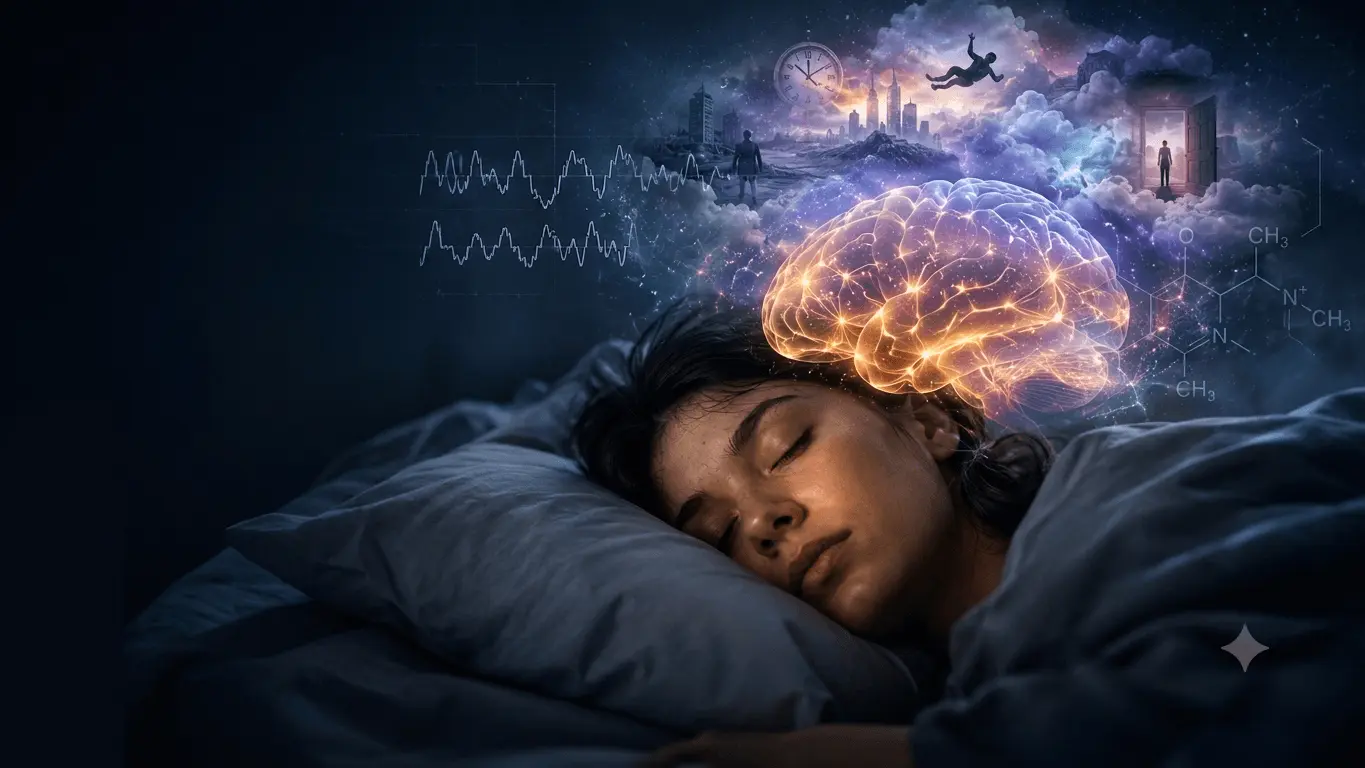
You are in your high school classroom and have just started a final exam when, halfway through a mathematics problem, you remember that you're wearing your slippers rather than your shoes. Your teacher then suddenly transforms into a talking golden retriever, who calmly goes on to explain the following question. The rest of the students around you do not react in any way—not even you do.
You don't laugh at how absurd things are until after you've woken up.
What do I think believed any of that?
It is something that almost everybody has at some stage wondered about. When we are dreaming, we frequently tolerate impossible things—for instance, flying, going to places which no longer exist, or having conversations with strangers. The situations in our dreams seem entirely real, and we accept them.
This curious paradox lies at the heart of one of neuroscience's most fascinating puzzles: why do dreams feel so real, even when they completely ignore the rules of logic?
For many years, scientists believed that sleep was merely a period during which the brain got a rest after a busy day. However, current research indicates that the brain, when asleep, is in fact quite active; at certain stages it becomes creative, emotional, and energetic, constructing entire worlds out of memories, feelings, and imagination.
The most clear-cut of these experiences take place during REM sleep and dreaming, a phase in which the brain temporarily alters the way that its various areas communicate. The networks which are responsible for visual imagery and emotional processing become very active, while those concerned with critical reasoning and reality testing become much less active. Rather than turning off, the brain shifts its focus.
Long before neuroscientists were able to observe such changes using brain imaging, Indian philosophers posed a different yet equally deep question: if the mind can create a whole world during sleep which feels just as real as waking life, what does that tell us about consciousness?
The explanations provided by neuroscience and those of the Upanishads come from entirely different traditions. Neuroscience looks at neurons, neurotransmitters, and measurable brain activity, while the Upanishads examine lived experience through philosophical discussion and meditation. The conclusions from both approaches must never be mixed or regarded as equivalent. Still, both start with the same observation—that the mind, when dreaming, treats its own creations as real during the time that they last.
To understand why this occurs, we have to look at one of the most remarkable changes that the human brain goes through each night.
The Brain Doesn't Go Offline at Night—It Changes Its Priorities
The way most people think about sleep is by imagining the brain slowing down gradually, just as a computer goes into standby mode.
In fact, the opposite is usually the case.
Sleep is an active process during which the brain carries out important tasks. It sorts through memories, works on emotions, eliminates unnecessary connections, and helps the body prepare for a new day.
Rather than remaining in a single state throughout the night, the brain cycles through a carefully orchestrated sequence of stages approximately every 90 minutes. These repeating dreams and sleep cycles include light sleep, deep sleep, and Rapid Eye Movement (REM) sleep, each characterized by distinct patterns of neural activity and unique physiological functions.
Even though dreaming does not happen only during REM sleep, the highly immersive and emotionally vivid, story-like experiences that most people remember are mostly linked with REM sleep and dreams.
Why?
The reason lies in the balance, or at times an imbalance, between various brain chemicals and networks.
Picture yourself entering a world-class film studio.
The artists are creating spectacular landscapes, the writers are crafting impressive stories, the musicians are producing moving soundtracks, and the editors are putting together scenes taken from thousands of hours of archived footage.
Now picture the studio's head fact-checker simply leaving the building.
The creative work continues.
On the contrary, it becomes even more imaginative.
Scenes which in normal circumstances would be regarded as impossible now completely make sense. The characters alter their identities without any explanation and places blend smoothly. Time either speeds up, slows down, or vanishes completely.
This is very much like what takes place in the brain when it is undergoing REM sleep and dreaming.
The brain systems involved in creativity, memory, and emotion are still very much active.
The system that asks itself whether this actually makes sense takes a temporary back seat.
The Chemistry That Makes Dreams Feel Real
Each thought, memory, emotion, and perception is based on communication among billions of neurons.
Neurotransmitters are chemicals that enable neurons to communicate with one another; some make us more alert, others have a relaxing effect, and some influence learning, attention, mood, or memory.
Among these chemical messengers, one plays an especially important role in the vivid world of dreaming:
Acetylcholine.
One of the best ways to understand the biology of dreaming is to look at acetylcholine and dreams, since this neurotransmitter acts differently during REM sleep than it does during many of the other stages of the sleep cycle.
Acetylcholine helps us concentrate, learn, and process what we see and hear when we are awake. Surprisingly, its levels rise once more during REM sleep, almost getting back to the same level as when we are awake.
At first sight, this appears to be contrary to what one would expect.
What is the reason why a brain, when it is sleeping, increases the activity of a neurotransmitter which is associated with alertness?
The solution is in the direction to which that activity is aimed.
Acetylcholine enables us to interact with the external world during the day.
While in REM sleep, it aids the brain in creating an internal one.
Imagine it as the operating system that underlies an advanced virtual reality simulator.
Your eyes are not receiving any new images.
Any external sounds are not influencing the narrative.
Nothing physical is happening around you.
Your brain still manages to create images of people you have known for decades, places you have never been to, conversations that never took place, and emotions so strong as to wake you up with a racing heart.
The ability to create realistic internal worlds is one of the key findings of modern dream neuroscience.
The brain, when it is dreaming, does not replay reality.
It is currently producing it.
🧠 Did You Know?
When you are asleep during REM sleep and dreaming, the areas of the visual cortex show activity levels similar to those observed when you are awake—even though your eyes are shut and no external light is reaching them. In this way, the brain acts as both the filmmaker and the audience, creating a fully immersive visual experience on its own.
When the Brain's Reality Checker Steps Aside
The creative energy responsible for dreaming comes from acetylcholine, and a different neurological change accounts for the fact that impossible events rarely appear impossible when they are occurring.
There is an area in the front part of the brain called the dorsolateral prefrontal cortex (dlPFC). Neuroscientists frequently link this region with executive functions including logical reasoning, planning, decision-making, working memory, and the ability to assess whether something is true or false.
You might regard it as the brain's built-in editor.
It carries out a huge number of reality checks all day long, and we are never aware of this.
It quietly asks:
- Is this physically possible?
- Does this align with the way I experienced it before?
- Is my understanding of this accurate?
- Ought I to question what I am seeing?
They constantly evaluate things so they can tell the difference between imagination and reality and keep a clear understanding of the world in which we live.
However, when in REM sleep and dreaming, the level of activity in this area decreases considerably.
The storyteller remains active.
The artist remains active.
The emotional orchestra is still going on.
However, the editor, the one who was supposed to question the narrative, temporarily reduces its voice.
The brain would become remarkably accepting of contradictions if there were no continuous reality checks.
A friend from when you were a child could later on become one of your university professors.
Your house may open right into an airport.
You might spend what seems like a whole afternoon talking to someone who died years ago.
Rather than rejecting these impossible scenarios, the brain, when dreaming, easily includes them in the developing narrative.
The fact that there is such a balance between increased creativity and less critical assessment is one of the best scientific explanations for the reason why dreams seem so real.
The dream fails to be convincing since the brain ceases to function.
It is so believable because the way the brain is functioning is different.
When Emotion Takes the Lead and Logic Steps Aside
Have you ever realized that the most odd aspect of a dream is not that impossible things take place—but that these things never appear impossible when you are dreaming?
The train suddenly shoots into the sky.
The house where you used to live when you were a child becomes your office.
A person whom you have never met uses the voice of your grandmother.
What is remarkable isn't the absurdity itself but your readiness to accept it completely.
From the perspective of dream neuroscience, this happens because dreaming is not governed by a single "dream center" in the brain. Instead, it emerges from an ever-changing conversation between multiple neural networks. During REM sleep and dreams, some of these networks become extraordinarily active, while others temporarily relinquish control.
The outcome is a mind that is extremely imaginative, deeply emotionally involved, and surprisingly lacks concern for logical consistency.
The Amygdala: Why Dream Emotions Feel So Powerful
Picture being at a film with outstanding cinematography and a soundtrack that is impossible to forget.
Even though the plot has some flaws, you can still end up speechless in terms of your emotional response.
Dreams work similarly.
The amygdala, which is one of the parts of the brain most responsive to emotion, is still very active during REM sleep and when dreaming. Despite its small size, this area has a vital function in assessing experiences that have an emotional significance.
Rather than asking whether something is true, the amygdala asks a different question:
How important does this thing seem to me?
The amygdala is what helps decide the emotional intensity associated with that moment, whatever you may be feeling—fear, excitement, grief, love, curiosity, or surprise.
In everyday waking life, the executive areas of the brain constantly regulate these emotional responses. When you take a shadow to be a person, logical reasoning soon deals with the mistake. And when you wake up from a nightmare, you console yourself by telling yourself that it was merely a dream.
Yet during REM sleep, the balance does shift greatly.
While the brain's emotional systems remain very active, the systems responsible for checking reality become relatively less active. For this reason, emotions tend to take the lead in the dream narrative.
Which is why dreams rarely seem to have no emotional content.
A simple conversation can seem extremely significant.
Missing an exam can cause intense panic.
Seeing someone you miss can bring real comfort or sadness.
The storyline could vanish within minutes of waking, but the emotional impression usually remains for hours, since the feelings were real even though the events that caused them were not.
This emotional authenticity is one of the strongest reasons why dreams feel so real.
🧠 Did You Know?
Functional brain imaging studies have on numerous occasions found increased activity in the areas of the brain involved in emotional processing when people are in REM sleep. This is why dreams are usually remembered more for the emotions they aroused than for the exact sequence of events.
The Hippocampus: Your Brain's Master Story Editor
Since the amygdala gives emotional intensity, another remarkable structure supplies a great deal of the raw material for dreaming.
Meet the hippocampus.
The hippocampus is often referred to as the brain's memory librarian and is therefore central to forming new memories and organizing recent experiences. Each day it gets an enormous amount of information—including faces, conversations, places, sounds, emotions, and a vast number of sensory details.
That is not the way dreaming is like pressing 'play' on a recording.
The hippocampus is capable of something a great deal more creative.
Picture a documentary filmmaker who has access to decades of archived film.
Instead of going over yesterday exactly as it took place, the filmmaker chooses individual scenes, mixes them with older memories, alters the order, and creates a completely new narrative.
That is similar to what the brain tends to do during REM sleep and when dreaming.
Pieces of memory act as building blocks rather than as complete items.
The holiday that took place ten years ago could easily be combined with yesterday's meeting.
One of your university friends could turn up at your childhood home.
A conversation that has recently taken place might happen in a city which you have never been to.
The fact that such odd combinations occur does not indicate that the brain is defective; on the contrary, they demonstrate one of its finest abilities—that of detecting connections between things which appear to have no relation.
In the field of dream neuroscience, dreams should therefore be seen as creative reconstructions rather than as accurate recordings of memory.
Acetylcholine and Dreams: The Brain's Creative Conductor
We had previously described acetylcholine as one of the key neurochemical characteristics of REM sleep.
Its role goes well beyond giving dreams a vivid visual form.
Imagine an orchestra as it is getting ready for a performance.
The different brain systems involved are memory, vision, language, emotion, perception, and imagination.
All the musicians are very skilled.
Nevertheless, their performance lacks coordination without a conductor.
During REM sleep and dreams, acetylcholine works like a conductor, enhancing communication across cortical networks involved in imagery, association, and internal attention. Rather than simply replaying stored information, the brain begins exploring new relationships between memories.
This helps explain why dreams often contain:
- People you know in places you don't.
- Conversations that never occurred.
- Swift changes from one stage of life to another.
- Powerful visual symbolism.
- Unexpected emotional connections.
The experiences seem spontaneous because the brain, when dreaming, is governed less by a sequence of events and more by associations.
One memory activates another.
One feeling brings up an earlier experience.
A person who is known will now be associated with a completely different location.
What results is an internal narrative that is always changing and at the same time seems remarkably coherent—even when judged by the standards of normal, awake reasoning, it looks entirely bizarre.
Why Dreams Ignore Time, Space, and Common Sense
At one moment you are at the school you attended as a child.
The next thing is that you are climbing a mountain with someone you have only just met.
The mountain then serves as your office without any explanation.
All of a sudden you're talking to a relative who died many years earlier.
The rules which waking consciousness regards as fundamental are regularly broken in dreams.
Time stretches and contracts.
Places merge.
People change identities.
Conversations jump easily from one decade to another.
Why?
One reason is that the brain, when dreaming, is no longer attempting to construct an objective model of the external world.
Rather, it creates a world based on experience.
Dreaming differs from waking consciousness, which continually updates itself through sensory information, in that it relies heavily on memories, emotions, and associations already inside the brain. Instead of asking itself,
Actually, did the events take place in the order mentioned?
It is asking something much simpler:
What experience should follow?
The decision is usually based on emotional importance rather than on a strictly chronological basis.
Which is why dreams can move smoothly from one period of life to another and yet remain psychologically coherent.
Might bizarre dreams have an evolutionary function?
One question continues to intrigue researchers:
What conceivable reason is there for evolution to retain a brain state that seems so irrational?
Although scientists have not yet reached a definite conclusion, various hypotheses are still being investigated.
Some researchers suggest that dreaming plays a role in helping the brain integrate memories and reinforce learning.
Some people believe that dreams provide a fairly safe environment in which emotional experiences can be processed.
Another idea, known as the Threat Simulation Theory, proposes that dreams may have provided our ancestors with opportunities to mentally rehearse responses to dangerous situations without facing real-world consequences.
At present, none of these hypotheses fully explains every aspect of dreaming.
The precise functions of dreams remain an active area of research.
What we do know is that dreaming isn't just random noise from a sleeping brain. It's the result of organized brain activity involving emotions, memories, perception, and brain chemistry.
The Vedic Connection: What Ancient Wisdom Says About the Reality of Dreams
For thousands of years, philosophers have wrestled with a question that remains surprisingly relevant today:
If a dream can feel completely real while we're experiencing it, what does that reveal about the nature of perception itself?
Modern dream neuroscience approaches this question by studying brain chemistry, neural networks, and sleep physiology. It asks how the brain constructs immersive dream experiences and why our ability to distinguish reality from imagination changes during REM sleep and dreams.
The sages of the Upanishads approached the same mystery from an entirely different direction.
Rather than examining the brain, they examined experience.
Their concern was not which neurotransmitters were active or which brain regions communicated during sleep. Instead, they asked a more fundamental philosophical question:
What is the nature of the consciousness that experiences both the waking world and the dream world?
These are different questions requiring different methods. One belongs to empirical science, the other to contemplative philosophy. Yet they intersect at a fascinating observation: the dream world feels real while it is being experienced.
The Mandukya Upanishad: Dreams as an Internally Experienced World
Among the principal Upanishads, the Mandukya Upanishad offers one of the most concise yet profound analyses of human consciousness.
Instead of classifying dreams as good or bad, prophetic or ordinary, it describes four fundamental states of experience:
- Jagrat – the waking state, where awareness is directed outward through the senses.
- Svapna – the dream state, where experience arises from the inner mind rather than current sensory perception.
- Sushupti – deep, dreamless sleep, characterized by the absence of differentiated mental activity.
- Turiya – the transcendent awareness that underlies and witnesses all three states.
For our discussion, Svapna is especially significant.
The Upanishad describes it as a state in which the experiencer inhabits a world illuminated from within. The dream does not depend on immediate sensory contact with the external environment. Instead, it unfolds through internally experienced mental phenomena.
Modern neuroscience reaches a similar observational endpoint through a different route.
During REM sleep and dreams, external sensory input is greatly reduced, yet the brain generates remarkably vivid visual scenes, conversations, emotions, and narratives.
The Upanishad explains this through the framework of consciousness.
Neuroscience explains it through neural activity.
Neither framework replaces the other.
Instead, they offer complementary ways of understanding why the dreaming mind can experience an internally created reality as though it were externally real.
🧠 Did You Know?
Unlike many later texts that focus on interpreting dream symbols, the Mandukya Upanishad is primarily concerned with understanding states of consciousness. Its discussion of dreams is philosophical rather than predictive or symbolic.
Why the Dream Doesn't Feel Unreal While You're Dreaming
One of the most intriguing observations made by both neuroscience and Vedantic philosophy is deceptively simple:
While we are dreaming, we rarely question the reality of the dream itself.
Neuroscience explains this by showing that executive regions of the prefrontal cortex—responsible for critical reasoning and reality testing—become less active during REM sleep and dreams. Emotional and perceptual networks remain highly engaged, allowing the dream narrative to unfold with little internal resistance.
The Upanishadic perspective approaches the same phenomenon differently.
It suggests that every state of consciousness possesses its own experiential validity while it is being lived.
During waking life, the physical world appears unquestionably real.
During dreaming, the dream world assumes that same sense of immediacy.
Only when consciousness shifts from one state to another do we recognize the limitations of the previous experience.
This observation is not presented as a scientific explanation of the brain. Rather, it is a philosophical reflection on how human beings experience reality across different states of awareness.
It is precisely this distinction that makes the comparison so fascinating.
Science explains how the experience is generated.
Vedanta reflects on what the experience reveals.
Beyond Logic: The Mind's Capacity to Construct Experience
Throughout this article, we've seen how acetylcholine and dreams, memory recombination, emotional processing, and reduced executive control contribute to dream experiences that are both vivid and irrational.
The Vedic tradition does not describe these biological mechanisms.
Instead, it invites us to notice something equally remarkable:
The human mind possesses an extraordinary ability to create convincing realities.
Every night, without opening our eyes or receiving fresh sensory information, we experience places we've never visited, conversations that never occurred, and emotions as powerful as those we feel while awake.
From a neuroscientific perspective, this reflects the coordinated activity of multiple brain systems.
From a philosophical perspective, it demonstrates how experience itself depends upon the state through which consciousness is functioning.
Rather than contradicting each other, these viewpoints explore different dimensions of the same phenomenon.
One asks:
"Which neural processes create this experience?"
The other asks:
"What does this experience tell us about the nature of perception?"
Both questions deepen our understanding.
Science and Vedic Philosophy: Two Different Lenses on the Same Experience
One of the greatest misconceptions surrounding ancient wisdom is the claim that modern neuroscience has somehow "proved" the Upanishads—or that the Upanishads predicted brain imaging.
Neither claim reflects good scholarship.
Ancient philosophical texts and modern neuroscience belong to different intellectual traditions. Their methods, aims, and standards of evidence are fundamentally different.
Where they become valuable together is not through forced equivalence, but through thoughtful comparison.
| REM sleep and dreams are associated with characteristic patterns of neural activity and brain chemistry. | Svapna describes dreaming as a distinct state of conscious experience independent of immediate sensory perception. |
| Elevated acetylcholine and dreams contribute to vivid internal imagery and associative thinking. | The dream world is experienced through an inwardly illumined mode of awareness rather than through the physical senses. |
| Reduced activity in executive brain regions weakens logical reality testing. | Each state of consciousness has its own internal coherence while it is being experienced. |
| Memory, emotion, and imagination combine to construct dream narratives. | Dream experience demonstrates the mind's capacity to generate convincing realities independent of the external environment. |
| Dream neuroscience investigates measurable biological mechanisms through observation and experimentation. | Vedanta explores the nature of consciousness through philosophical inquiry and contemplative insight. |
Rather than asking readers to choose one perspective over the other, this comparison highlights an important truth:
Science helps us understand the mechanisms of dreaming. Philosophy helps us reflect on the meaning of the experience.
Together, they remind us that dreams are not just interesting brain activity, but also a lasting source of human curiosity. Both science and philosophy invite us to explore them.
What You Can Do Tonight: Working With Your Sleeping Brain
Learning why dreams feel so real is more than just a fun question. It helps us understand how the brain handles emotions, memories, and experiences during sleep. While we can't control most dreams, research shows that good sleep habits help the brain do its job at night.
Traditional Indian wellness systems also see Nidra (sleep) as key for both body and mind. In Ayurveda, sleep is one of the three main pillars of life, along with food (Ahara) and balanced living (Brahmacharya). The focus here isn't on dream meanings, but on the importance of good sleep for health.
Whether viewed through neuroscience or Ayurveda, one principle remains remarkably consistent: better sleep supports a healthier mind.
1. Protect Your REM Sleep
The longest periods of REM sleep and dreams usually occur during the final third of the night. Regularly shortening your sleep doesn't simply reduce total sleep—it often reduces the amount of REM sleep your brain experiences.
REM sleep is important for handling emotions, learning, and memory. If you often cut your sleep short, you might feel less refreshed both mentally and emotionally.
Practical Tip: Whenever possible, aim for 7–9 hours of sleep and maintain a consistent sleep schedule, even on weekends.
2. Give Your Brain a Calm Landing Before Bed
The brain doesn't instantly switch from problem-solving mode into restorative sleep.
Exposure to bright screens, work-related stress, emotionally stimulating content, or late-night social media can make this transition more difficult.
Creating a calming bedtime routine helps prepare the brain for healthy dreams and sleep cycles.
Simple habits can make a meaningful difference:
- Dim lights during the last hour before bed.
- Avoid checking work emails late at night.
- Read a physical book instead of scrolling on your phone.
- Practice a few minutes of slow breathing or gentle meditation.
Research on sleep habits supports these tips, and they can help you fall into deeper, more restful sleep.
3. Record Your Dreams Before They Fade
One of the easiest ways to improve dream recall is surprisingly simple:
Write your dream down as soon as you wake up.
Dream memories fade rapidly because the neurochemical environment changes almost immediately after waking. Even waiting five or ten minutes can make many details disappear.
Keeping a dream journal might not uncover secret meanings, but it can help you spot emotional patterns, track changes in your dreams, and become more aware of your sleep over time.
4. Pay Attention to the Emotion, Not Just the Story
When people remember dreams, they often focus on the strange events:
"Why was I flying?"
"Why was my childhood home floating in space?"
Yet from the perspective of dream neuroscience, the emotional tone of the dream may be more informative than its literal storyline.
Ask yourself questions like:
- How did the dream make me feel?
- Was I anxious, joyful, curious, or relieved?
- Did that emotion resemble something I experienced recently?
This doesn't mean every dream has a secret message. Instead, it encourages you to think about the real emotions your brain created during the dream.
5. Appreciate Dreams Without Over-Interpreting Them
Dreams have fascinated humanity for thousands of years, inspiring scientific investigation, philosophical reflection, literature, and spiritual inquiry.
That fascination sometimes leads to an understandable temptation: to assume every unusual dream contains a profound message or predicts future events.
Neither neuroscience nor authentic classical Indian philosophy supports such a sweeping conclusion.
Modern sleep research suggests that dreams arise through complex interactions among memory, emotion, brain chemistry, and ongoing neural activity.
Similarly, traditional Indian texts distinguish between different kinds of dreams and do not treat every dream as spiritually significant or predictive.
If we stay curious about our dreams instead of looking for definite answers, we can enjoy them without forcing meanings that might not be there.
Dream Myth vs. Reality
Dreams have inspired myths across cultures, but many popular beliefs don't align with either modern science or authentic classical teachings.
| Every dream predicts the future. | Classical Indian traditions distinguish between ordinary dreams, physiological dreams, and those regarded as significant under specific circumstances. Most dreams are not treated as predictive. |
| Dreams happen only during REM sleep and dreams. | Dreams can occur in multiple sleep stages, although the most vivid and emotionally immersive dreams usually occur during REM sleep. |
| Strange dreams indicate something is wrong with your brain. | Bizarre dream narratives are a normal consequence of the changing balance between emotional processing, memory networks, and executive control during sleep. |
| Dreams are meaningless random brain activity. | Current dream neuroscience suggests that dreams emerge from complex interactions among memory, emotion, perception, and brain chemistry. Researchers continue to investigate their precise functions. |
| Ancient scriptures scientifically explain dreaming. | Traditional philosophical texts explore the subjective experience of dreaming, while neuroscience investigates its biological mechanisms. These perspectives address different questions. |
Final Thoughts: The Sleeping Brain Never Stops Creating
Every night, as the world around you grows quiet, your brain begins one of its most remarkable performances.
Even with your eyes closed and no new information coming in, your brain creates scenes, conversations, feelings, and stories that feel real. During REM sleep, changes in brain chemistry let imagination, memory, and emotion work together, while the usual reality checks quiet down. This is a key reason why dreams seem so real.
Yet dreaming also reminds us that science is not the only lens through which human experience has been explored. Long before brain scans revealed the neural choreography of sleep, philosophers reflected on the mysterious ability of the mind to create entire worlds from within. Their questions were different, but their curiosity was the same.
Perhaps that is why dreams continue to captivate us.
Dreams show us how creative the sleeping brain can be and remind us of our deep wish to understand consciousness. Whether we look at them through science or philosophy, dreams invite us to wonder at the mind's power to create and experience a world all its own.
0 Comments