
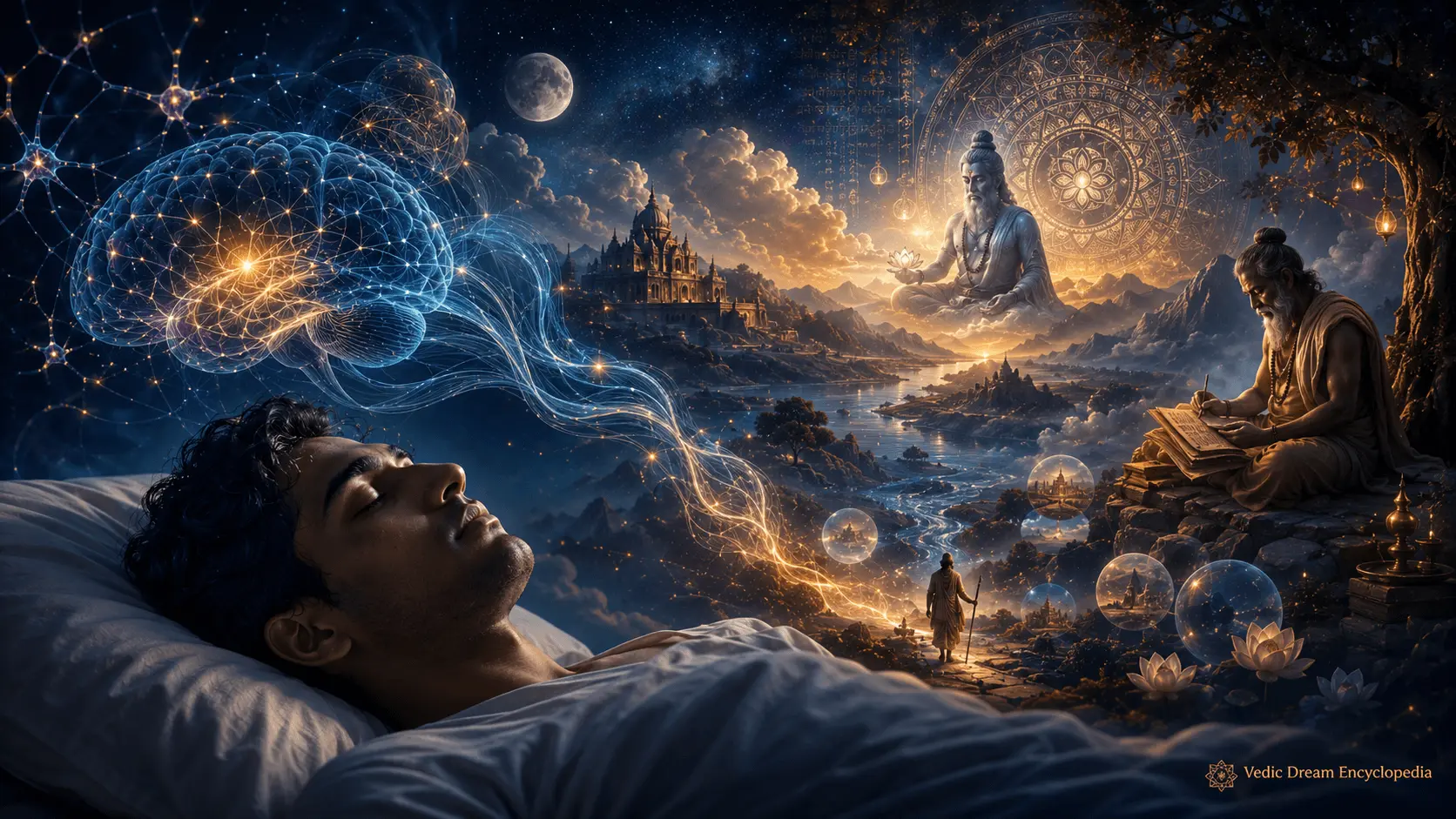
Have you ever woken up from a dream so vivid that you could still recall the feel of a wall, the warmth of sunlight, or the face of someone you met? For a moment, it all seemed real, even though you never actually saw those places or moved your body.
How does the brain create such astonishingly lifelike experiences every night?
Modern neuroscience offers an interesting answer. During REM (Rapid Eye Movement) sleep, your brain shifts into a unique chemical state. Acetylcholine becomes much more active, while noradrenaline (also known as norepinephrine) drops to very low levels. Together, these changes let your sleeping brain create vivid virtual worlds.
Interestingly, this scientific finding lines up with an old idea from the Vedic tradition called Taijasa. Taijasa is described as an inner light of consciousness that experiences dream worlds without relying on the physical senses.
Let’s see how modern brain science and ancient Vedic wisdom both help explain one of humanity’s biggest mysteries.
Why Dreams Feel So Astonishingly Real
When you're awake, your brain constantly balances information from two worlds:
- External sensory input arriving through your eyes, ears, skin, nose, and tongue.
- Internal imagination, memories, and thoughts.
During REM sleep, this balance changes a lot.
Instead of using information from your senses, the brain creates a whole world from the inside.
What’s amazing is that the brain uses many of the same networks for vision, emotion, and memory as it does when you’re awake. The main difference is the mix of brain chemicals in charge.
Meet the Brain's Dream Architects
Two neurotransmitters play especially important roles:
| Acetylcholine | Moderate to high | Very high |
| Noradrenaline | High | Extremely low |
This special mix sets up the ideal conditions for vivid dreams.
Acetylcholine: The Brain's Internal Graphics Engine
Imagine playing an advanced virtual reality game.
Normally, the computer gets information from cameras and sensors. But what if it stopped getting outside input and created a whole digital world inside itself instead?
This is similar to what acetylcholine helps your brain do during REM sleep.
High acetylcholine activity stimulates regions involved in:
- Visual imagery
- Spatial environments
- Memory integration
- Emotional processing
- Scene construction
The result is a three-dimensional world inside your mind that feels real, even though your eyes are closed.
Instead of only replaying memories, the brain actively creates dream scenes, often blending parts of past experiences into new places.
That’s why dreams often include impossible places that still seem completely normal while you’re dreaming.
Why Real-World Logic Quietly Disappears
If dreams are so unrealistic, why don't we immediately recognize them as dreams?
The main reason has to do with noradrenaline.
Noradrenaline normally supports:
- Logical reasoning
- Reality testing
- Sustained attention
- Threat assessment
- Executive decision-making
During REM sleep, noradrenaline levels drop sharply.
Without its normal influence:
- Contradictions seem acceptable.
- Time behaves strangely.
- People change identities without surprise.
- Impossible events feel completely normal.
Your brain stops checking whether what you’re experiencing matches the real world.
Instead, it treats these inner experiences as if they’re real, at least for a while.
That’s why you usually don’t question strange things in dreams until you wake up.
The Perfect Neurochemical Combination
Together, these neurotransmitters create a fascinating balance:
High acetylcholine builds an immersive dream world.
Low noradrenaline reduces critical evaluation of that world.
This creates dreams that feel real, full of emotion and detail, even if they break the rules of the real world.
This isn’t a mistake. It’s a normal part of REM sleep that helps with emotions, memory, and creativity.
How the Sleeping Brain Creates an Internal Reality
Even though your senses are mostly quiet during sleep, your brain doesn’t just turn off.
Instead, many parts of your brain stay very active.
Areas involved in:
- visual imagery,
- emotional significance,
- autobiographical memory,
- and spatial navigation
continue communicating with one another.
Meanwhile, activity in regions associated with executive control and critical self-monitoring is relatively reduced.
The result is similar to having a high-tech virtual reality simulator running inside your mind.
The Vedic Connection: How Ancient Texts Explained This Science
Long before scientists discovered neurotransmitters, the Vedic tradition said that dreams come from within and don’t depend on the physical senses.
The Mandukya Upanishad describes the dream state (Svapna) as a distinct mode of consciousness experienced by Taijasa.
Taijasa literally means "the luminous one" or "the radiant consciousness."
Unlike the waking experiencer, who perceives the external world through the senses, Taijasa experiences an inner world composed of subtle impressions.
According to the Upanishadic teaching:
- External sensory organs are inactive during dreaming.
- The mind projects its own experiences internally.
- Dream objects are experienced through subtle cognition rather than physical perception.
This matches surprisingly well with what modern neuroscience says.
Neuroscience explains that REM sleep creates vivid inner experiences through changes in brain chemistry. The Vedic view says that, in dreams, consciousness experiences subtle inner forms without using the senses.
Neither perspective contradicts the other.
Instead, both describe the same thing, just in different ways:
| High acetylcholine enhances internally generated imagery | Taijasa experiences internally projected subtle forms |
| External sensory input is largely disconnected | Physical senses become inactive during Svapna |
| Dream environments arise within brain networks | Dream experiences arise through the subtle functioning of mind |
| REM creates immersive subjective worlds | Svapna is an internally experienced state of consciousness |
Dreams, Samskaras, and the Mind
Classical Indian philosophy also says that dreams often come from Samskaras, which are subtle mental impressions left by past experiences.
These impressions may combine, reorganize, and manifest symbolically during dreams.
Modern neuroscience similarly shows that REM sleep involves extensive interaction between memory systems, emotional networks, and associative brain regions.
Importantly, neither tradition claims that every dream predicts the future or carries spiritual significance.
Many dreams reflect ongoing mental processing, emotional regulation, and stored impressions.
So, real dream interpretation needs context, not just general meanings from a dream dictionary.
The Ayurvedic View of Dream Formation
Ayurveda also recognizes dreaming as a natural function of the mind.
Classical Ayurvedic texts describe that the qualities of Vata, Pitta, and Kapha can influence the nature of dream experiences.
Examples include:
- Vata predominance: movement, flying, fear, instability, travel
- Pitta predominance: fire, light, conflict, intense colors
- Kapha predominance: water, flowers, peaceful scenes, stability
These descriptions relate to your body type and physical state, not strict symbolic meanings.
Ayurveda sees dreams as just one clue among many that can help in understanding a person’s overall health and mind.
Practical Biohacks to Support Healthy REM Sleep and Dream Recall
You can’t directly control acetylcholine or noradrenaline each night, but good sleep habits help your brain’s natural REM cycles.
1. Prioritize Consistent Sleep Timing
Going to bed and waking up at the same time every day helps keep your REM sleep healthy.
If your schedule is irregular, your REM sleep can become disrupted.
2. Allow Enough Total Sleep
REM sleep periods get longer as the night goes on.
If you often cut your sleep short, you might miss out on vivid dreams and important memory processing.
3. Reduce Evening Alcohol Intake
Alcohol can reduce REM sleep early in the night and cause disrupted sleep later, making dreams less continuous.
4. Keep a Dream Journal Beside Your Bed
Dreams fade quickly after you wake up.
Writing down even a few details right after waking up helps you remember your dreams more clearly over time.
Why This Matters Beyond Dreams
Learning about REM sleep chemistry is helpful for more than just satisfying curiosity.
Dreaming reflects the brain's remarkable ability to:
- process memories,
- integrate emotions,
- generate creative associations,
- and simulate experiences without external sensory input.
At the same time, the Vedic idea of Taijasa reminds us that people have long known we can experience inner worlds beyond what we see when awake.
Modern neuroscience explains how the brain creates vivid dream experiences.
Ancient Vedic wisdom explores how consciousness experiences those subtle inner worlds.
Together, these views give us a deeper and more balanced understanding of dreams than either could alone.
If you're curious about the deeper meanings of your dreams, keep exploring the Auspicious Dreams and Ayurvedic Dream Guides on Vedic Dream Encyclopedia. These resources help you understand dream symbols using authentic traditional sources instead of general dream dictionaries.
Frequently Asked Questions (FAQs)
Why do dreams feel more real than imagination?
During REM sleep, high acetylcholine activity enhances internally generated sensory imagery, while very low noradrenaline reduces reality testing. This combination makes dreams feel immersive and convincing.
Does the brain see through the eyes during dreams?
No. During dreaming, the eyes are largely disconnected from external visual input. The brain generates visual experiences internally using memory, imagination, and active visual processing networks.
What is Taijasa in the Vedic tradition?
Taijasa is the experiencer of the dream state (Svapna) described in the Mandukya Upanishad. It refers to the luminous consciousness that experiences internally projected dream forms without relying on the physical senses.
Does Ayurveda believe every dream has a hidden meaning?
No. Ayurveda recognizes that many dreams arise from physiological conditions, mental impressions (Samskaras), or the influence of Vata, Pitta, and Kapha. Not every dream is considered predictive or spiritually significant.
Can improving sleep make dreams more vivid?
Maintaining a consistent sleep schedule, getting sufficient sleep, minimizing factors that disrupt REM sleep, and keeping a dream journal can improve dream recall and support healthy dreaming.
0 Comments